By: Henk Holtslag and Frank van Steenbergen
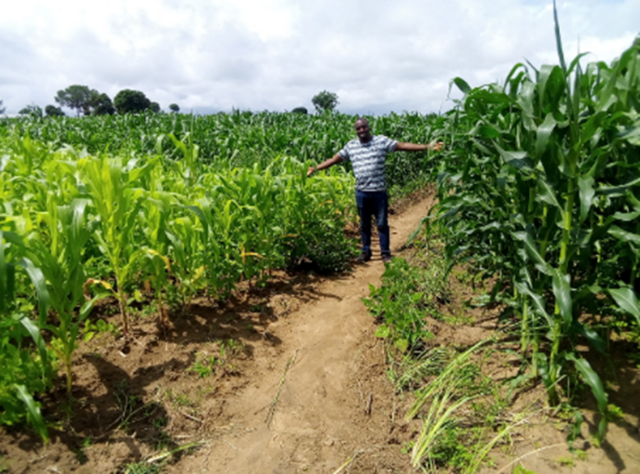
Message on World Water Day. And a reminder where to put our efforts, talents, dedication, cooperative spirit and love.
Here is a genuine struggle:
- In many parts of the world food security remains a challenge – soils have been depleted and we live in a world where groundwater reserves are going down. We may live on borrowed water-time.
- And still: 320 million people in rural areas in Sub Saharan Africa for instance lack basic water services. The model of reticulated community piped water systems has made a difference in many areas, at the same time in several areas it is out of reach – no investment or too many barriers to maintain, including access to spare parts and financial organization.
Yet against these struggles, there are many things that can be done, which are not done yet: simple, basic and effective. Here is one: deep bed farming. It comes in the menu of rainwater harvesting options that have made a huge impact in so many places.
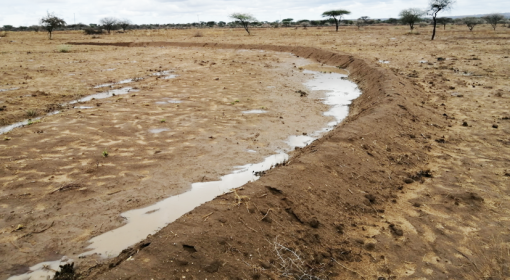
Deep bed farming starts with breaking the hardpan in soil. The hardpan is the often-human induced impermeable ground layer that occurs in many places. The hard pan can be caused by decades of cultivation and ploughing – fine soil particles travel down and farm an impenetrable barrier within the soil. The result is that water does not percolate deeply, affecting soil moisture and the opportunities to recharge. In deep bed farming the hard pan is broken and boxed trenches are excavated inside the farmland to collect rainwater and run off and allow it to gradually quench the otherwise dry soil. The boxed trenches may go 30-60 centimetres deep. The trenches provide the conduit for rain and run off water to collect and percolate sideways into adjacent soil. Raised beds are made, often in combination with several regenerative techniques: mulching, applying organic fertilizer, and planting nitrogen fixing enhancing plants – such as Seshbania or Tephrosia Vogelii. Where soils are poor, small quantities of inorganic P fertilizer may be used to boost overall impact[1].
Results of this essential method have been convincing in different dimensions. Yields increased significantly: a survey of 111 first adopters in Malawi[2] mention two-fold to three-fold yield jumps. This often happens in rainfed farming, if cultivation is no longer in the moisture stress/ wilting bandwidth. This led to a second dimension of positive impact. Deep bed farming promoted itself forward, with most adopters (78%) expanding the use of technique on their own land and other farmers following the example. This is how within a short time 20,000 farmers in Malawi adopted deep bed farming combined with the other regenerative farming methods.
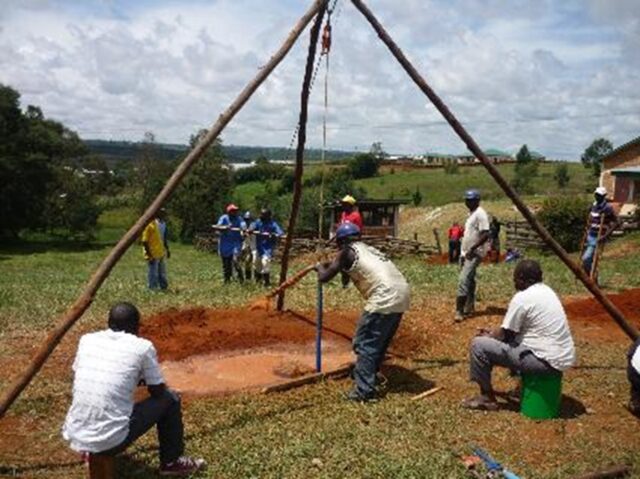
It also sets the scene for success in a third dimension: better recharge. Deep bed farming – sometimes in combination with other water harvesting methods – can replenish shallow water bearing strata. This opens possibilities for local community wells – developed by different manual drilling techniques, complemented by basic lifting techniques such as EMAS or rope pumps. These create work for local artisans – and a fourth dimension of positive change is touched upon, that of stronger local economies providing employment and offering useful goods and services.
[1] https://onlinelibrary.wiley.com/doi/10.1155/2014/902820
[2] https://www.tiyeni.org/uploads/1/5/0/2/150218295/mvula-and-dixon-2020-research-briefing-2017-adoption-study.pdf