By Anastasia Deligianni and Giorgos Deligiannis
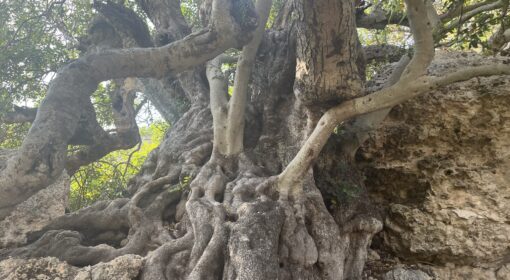
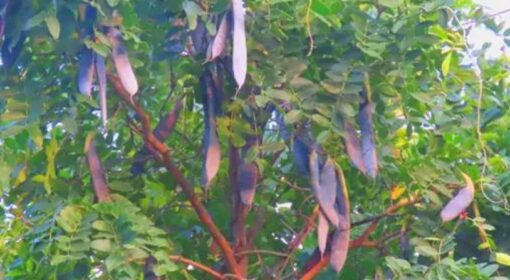
The carob tree (Ceratonia siliqua) is one of the most characteristic trees of the Mediterranean and has accompanied human societies for thousands of years. Its scientific name comes from the ancient Greek word keration, meaning small horn, referring to the shape of the fruit pods, while the Latin siliqua means pod. The word carob derives from the Arabic word kharrūb, reflecting the spread of the plant throughout the Mediterranean through trade and cultural exchanges. Since ancient times, carob pods were used as a unit of measurement for precious stones because they have an almost constant weight; from this practice comes the word carat, which is still used tday in jewelry. In many regions of the Mediterranean, carob has long been used as food for both people and animals, as its pods are rich in natural sugars and nutrients, making them a valuable and energy-rich source of nourishment.
Today, carob products have returned to the spotlight with renewed interest, particularly in the context of plant-based, traditional, and functional foods, as carob-based preparations are used for syrups, flour, natural sweeteners, and even in the food and cosmetics industries (Discover Crete).
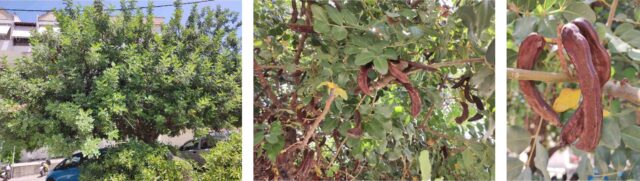
In a garden in Mytilene, the capital of Lesvos, this old knowledge continues to live on in a very personal way. About 34 years ago, when his daughter was born, Giorgos planted a carob tree in his garden. Over the years the small tree grew and began producing its first fruits. That is when curiosity emerged: what can one do with so many carobs? Giorgos, who is a chemist by profession and has always had a love for natural materials and experimentation in the kitchen, began asking older people on the island and searching for old recipes. Gradually, he started trying different preparations himself and creating products from the fruits of his carob tree.
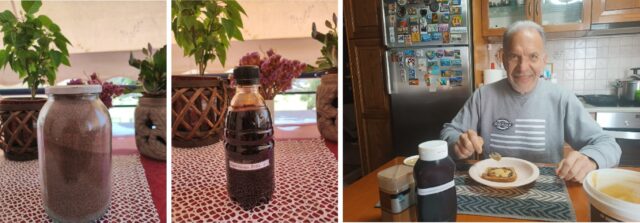
Among these, two became his favorites: carob syrup and carob flour.
The harvesting of the carob pods takes place in mid-August, when the fruits have developed a dark brown color and a hard texture.
To make carob syrup, he washes the pods well with water and lets them dry. He then cuts the pods into small pieces, about 1 cm long, places them in a pot, and adds water until they are covered. He leaves them to soak in warm water for at least 24 hours. Afterwards he adds a little more water, as some has been absorbed by the pods, and places the pot on the heat. Once the mixture comes to a boil, he strains the liquid, which contains most of the substances from the fruits. With the first extraction he collects about 65% of the soluble substances.
He then repeats the process once more in order to collect about 95% of the soluble substances. Afterwards he mixes the two extracts and boils them until they become a thick, dark syrup with a rich aroma. He removes it from the heat when strong bubbles begin to appear, a sign that the syrup has thickened. With this process, from 1 kilogram of carob pods he produces about 500 grams of carob syrup
Carob syrup is used in many ways: as a spread on bread or rusks, in yogurt, in salads as a sweet dressing, but also in cooking recipes and desserts. Its taste resembles a mixture of honey and grape molasses, with a strong aroma and deep flavor.
Carob flour is made from dried carob pods, which are first washed and left in the sun to dry, as in the case of carob syrup. They are then ground and the flour is sifted to produce a fine powder. The net weight of the final product is almost the same as the weight of the pods used, since only small residues of seeds and peel are removed. Carob flour can also be used as a naturally sweet, caffeine‑free alternative to cocoa in baking and chocolate‑like products, giving desserts and drinks a similar rich color and flavor without the bitterness of traditional chocolate.
All of this started simply from a tree in the garden. Today this carob tree stands tall and strong, offering shade in the summer and fruits every year. Like many Mediterranean trees, it has deep roots, withstands drought, and can grow without any irrigation. At the same time, it provides shelter for insects and birds, contributing to the small but important biodiversity of an urban garden. Its fruits offer nutritious and natural food options, while its story reminds us that many of the valuable elements of our diet and culture are already around us, deeply rooted in the landscape of the Mediterranean.
References
Creta Carob. (2023, June 22). Carob: the “black gold” of history. Creta Carob. Retrieved March 10, 2026, from https://www.cretacarob.com/en/to-charoypi-o-mayros-chrysos-tis-istorias/
Discover Crete. (n.d.). Carob Tree (Ceratonia siliqua). Discover Crete. https://www.discovercrete.com/content/carob-tree-ceratonia-siliqua
Wikipedia. (n.d.). Carob. https://en.wikipedia.org/wiki/Carob