By tiipaalga, APIL, supported by Aida Zare, and Femke van Woesik
This blog is part of a dossier on locally-led adaptation, featuring insights and lessons from the Reversing the Flow (RtF) program. RtF empowers communities in Bangladesh, Burkina Faso, Ethiopia, Kenya, and Sudan to build climate resilience through direct funding and a community-driven, landscape approach.
In Locally-Led adaptation (LLA), funding moves closer to communities than in most traditional climate programmes. This creates opportunities for real ownership, but it also brings risks. When money enters systems built on trust and social relationships, financing becomes as much a social process as a technical one.
In the RtF program, local NGOs (called hubs) receive money from the donor and regrant this money directly to the local communities in their landscapes. Two hubs in Burkina Faso, APIL and tiipaalga, show how funding arrangements can strengthen, not destabilize, locally-led processes when they are handled with care, transparency, and reflective learning.
Managing funding delays without losing momentum
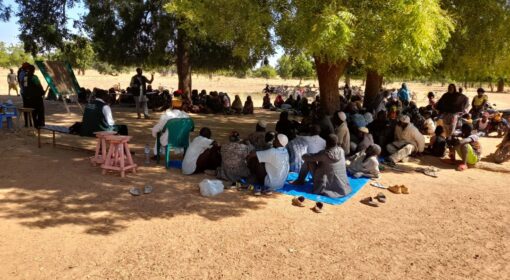
The hub APIL faced a delay between the inception phase and fund disbursement. Instead of pausing, the team used this time to stay close to the villages by continuing immersion missions, holding discussions with community, encouraging reflection on priorities and capacities. When funds finally arrived, communities were prepared and aligned around their plans. The delay strengthened ownership rather than weakening it.
Still, this adaptive response came at a cost. Local NGOs with limited staff absorb the operational pressures created by funding delays, even though timely disbursement is a donor responsibility. Unpredictable flows can undermine trust, disrupt planning, and stretch teams already working at capacity.
Protecting social cohesion around money
Both hubs understand that finances can damage relations if not managed transparently. This awareness shaped the way they structured their processes:
APIL | Tiipaalga |
|
|
Working with real institutional constraints
Both hubs treat financing as part of the social architecture of LLA, not as an administrative component. Burkina Faso’s political and administrative context adds another layer of complexity. APIL discovered that many CVD offices had not been updated, complicating account opening and legal recognition. Tiipaalga faces similar challenges but leverages committee formation to establish clear documentation that microfinance institutions can use to open accounts. LLA financing thus must adapt to actual institutional realities, not idealized structures.
Letting communities define fairness
Both hubs rely on existing social knowledge for beneficiary selection. Communities understand vulnerability profiles, family situations, and who benefits from collective versus individual investments.
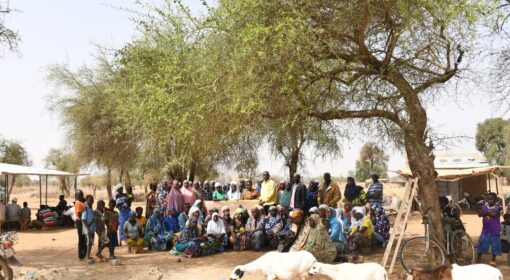
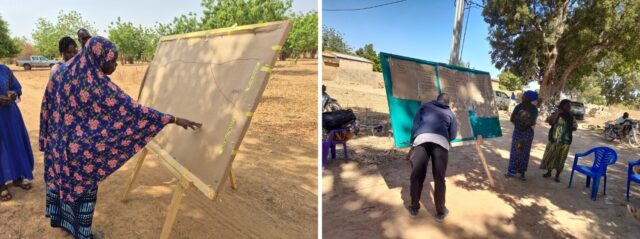
One example reflects the strength of this approach: In Moanega, three people applied for support for land protection, a costly intervention. One candidate was the CVD president. After discussion, the others stepped back, agreeing that another applicant needed support more. This outcome did not come from a targeting guideline or external criteria. It came from trust, discussion, and community ethics, which are the true foundations of equitable locally led financing.
What financing really means in LLA
The Burkina Faso hubs show that financing in LLA is not simply about regranting money. It is about:
- Preparing villages to manage funds
- Reinforcing governance
- Preventing conflict
- Keeping decisions transparent
- Understanding institutional constraints
- Adapting plans to funding realities
- Maintaining social cohesion
Most importantly, financing becomes part of the learning loop. Communities refine priorities based on available funds. Hubs revisit plans after baseline studies. Everyone adjusts rather than forcing a fixed project design.
The Burkina Faso experience suggests several principles for financing locally led adaptation:
- Financing must follow governance, not the other way around.
- Transparency is a daily practice, not an annual audit.
- Community processes must guide beneficiary selection, not external criteria.
- Institutional realities shape what is possible, and programmes must adapt.
- Preparation matters as much as disbursement.
- Funding delays can strengthen ownership if handled well.
- Social cohesion is a core part of financial risk management.
LLA financing is a process that can strengthen community agency, reinforce trust, and support long-term resilience and LLA becomes real when funding is not only devolved, but understood, owned, and governed by the people who live with its consequences.