By Pratik Ranjan, Frank van Steenbergen, Arpan Mondal, & Shubham Jain, GOPA MetaMeta
In Jharkhand’s Godda district lies the village of Mahuatand, where farmers have long battled a relentless adversary: rodents. They are not alone, there are many Mahuatands in all districts and states of India. While national agricultural strategies emphasize pest control, rodents are often not considered major pests—yet the devastation they cause in the field and during post-harvest remains largely overlooked.
Recognizing this gap, an Ecologically Based Rodent Management (EBRM) program in Mahuatand was initiated[1], setting the stage for a transformative journey over one year.
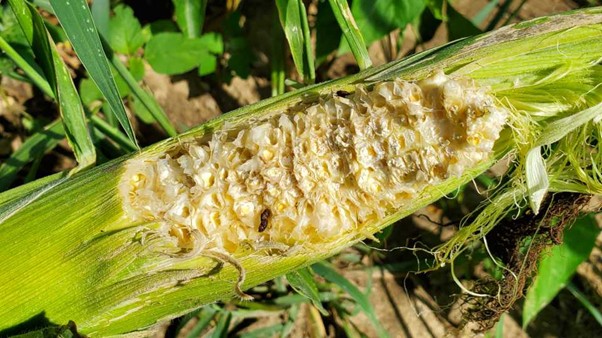
The Overlooked Menace
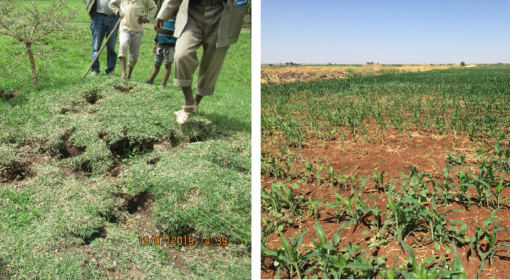
For years, rodents have caused damage not only to standing crops but also to stored produce and household items. Crop losses were visible in the fields—cut stems, damaged panicles, and hollowed grains—while in homes, stored grains, clothes, and even electrical wires were frequently destroyed. In Jharkhand, field observations indicate that rodent damage was in the range of 15–20%, with higher losses during severe infestations. For smallholder families, such reductions directly affect household income and food availability. Beyond economic losses, rodents also contaminate food and water and can spread infections, creating additional health risks in rural communities.
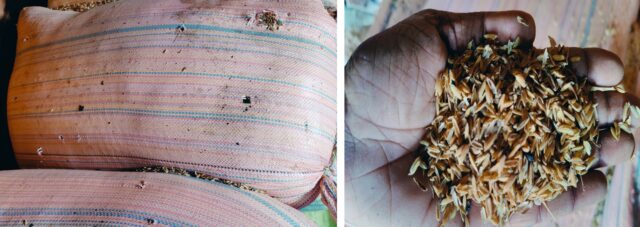
Master Murmu, a resident, recalls the challenge:
“We were very much upset by these rats because they were not only damaging the agri-produce but even our daily household products like clothes, wires, etc.”
This sentiment was widespread. Many farmers felt resigned to their fate, believing:
“What can we do? Rats will come and eat; there is no solution. We have tried multiple methods but they remained ineffective.”
Rodent infestation directly affects household food availability, especially in smallholder systems where even minor yield losses can threaten food security. Despite this, systematic ecologically-based rodent management approaches had never been implemented in the village.
Laying the Foundation: Awareness and Collective Action
The EBRM intervention in Mahuatand began with dialogue and reflection. Through village meetings, farmers discussed the scale of rodent damage—not only in standing crops but also in stored grains and household items. What had long been accepted as an unavoidable problem was reframed as a serious food security concern. Reducing these avoidable losses became a practical entry point for strengthening smallholder resilience.
During these discussions, the principles of Ecologically Based Rodent Management (EBRM) were introduced: controlling access of rodents to food, shelter and water, based on an understanding of their ecological patterns. Farmers learned that effective rodent control depends not on isolated actions, but on synchronized and community-led efforts. Rather than relying solely on chemical rodenticides, EBRM emphasizes ecological balance, burrow monitoring, and collective timing of interventions.
To initiate action, one tola (hamlet) was selected for a pilot effort. Farmers were provided with mechanical rat traps and trained in proper placement. The initial response was encouraging.
Sita Soren, a farmer from the tola, shared:
“The traps worked, and we were very happy. It became a routine that for the initial few days, every day we caught rats.”
However, as rodents adapted and trap effectiveness declined, the community realized that individual methods alone would not provide lasting results. This learning became the turning point—laying the foundation for synchronized village-wide burrow management and fumigation.
A Unified Front: The Power of Collective Fumigation
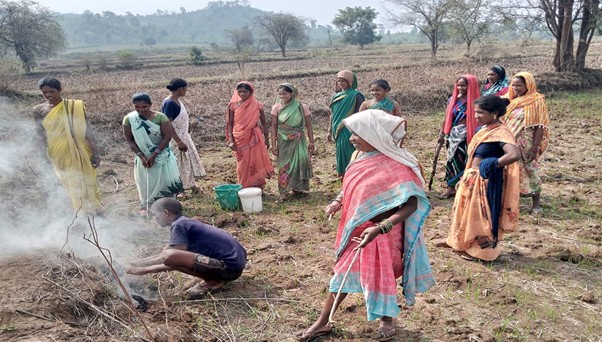
Building on this momentum, the community embraced collective action. All 50 families of the hamlet participated in a coordinated burrow identification and fumigation drive. The process included:
- Initial burrow counting and mapping across fields and homesteads to identify all visible rodent holes.
- Sealing of all identified burrows during the first visit to establish a baseline.
- Follow-up visit after one week to observe and record reopened holes, which were identified as active burrows.
- Simultaneous fumigation of all active burrows as part of a coordinated community drive.
- Post-fumigation monitoring after one week to assess reopened burrows and evaluate the effectiveness of the intervention.
This concerted effort forced many rats out of hiding, leading to a reduction in the rodent population by more than 50%. The success of this initiative became a testament to the power of community-driven EBRM strategies.
Sustaining Momentum: Adoption of New Practices
Encouraged by their achievements, farmers began exploring additional EBRM techniques. Some adopted the use of bird perches in their fields to attract natural rodent predators. While currently limited in number, there is optimism that this practice will gain traction in the upcoming farming season.
Reflecting on a Year of Progress
From a state of resignation to proactive engagement, Mahuatand’s journey over the past year underscores the power of awareness, collective action, and practical interventions. The positive changes affirm that with the right vision and community involvement, farmers can effectively combat rodent challenges.
As EBRM practices continue to evolve in Mahuatand, they offer a promising blueprint for other regions grappling with similar issues. Through unity and innovation, Mahuatand’s farmers have illuminated a path toward sustainable rodent management, ensuring better livelihoods and food security for their community.
[1] Implemented by GOPA MetaMeta under the RVO-supported program Agricultural Transformation through NBS and Productive Biodiversity.