By tiipaalga, APIL, supported by Aida Zare, and Femke van Woesik
This blog is part of a dossier on locally-led adaptation, featuring insights and lessons from the Reversing the Flow (RtF) program. RtF empowers communities in Bangladesh, Burkina Faso, Ethiopia, Kenya, and Sudan to build climate resilience through direct funding and a community-driven, landscape approach.
Locally-led adaptation (LLA) is often described in terms of funding flows and participation. Yet beneath these visible elements sit something quieter that determines whether LLA works in practice: who actually governs decisions in the village, and how.
The recent exchanges between local NGOs (hubs) APIL and tiipaalga in Burkina Faso show how much depends on getting this right. Both hubs are moving to concrete governance arrangements that can carry responsibility, handle money, and keep decision-making where it belongs: with the community.
Tiipaalga: village committees, elders, and a municipal steering space
Tiipaalga works in the Ziga watershed, in villages that already had experience with improved cookstoves. From this starting point, the team used participatory tools to understand local priorities: land maps to document resources and infrastructure, historical timelines to trace 20 years of climate events and coping strategies, and Venn diagrams to map local institutions and potential synergies.
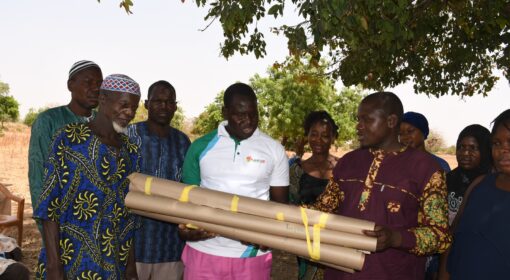
On this foundation, each village created a management committee. The rules were simple and important: members are nominated by the community, every neighborhood is represented, and women and youth must be included. These committees lead the planning based on the issues/challenges and solutions identified during the baseline assessment.
In one village, people chose to add an advisory council of elders to accompany and guide the committee’s work. That detail matters. It shows how governance is not designed in an office but grows out of how authority and legitimacy already function locally.
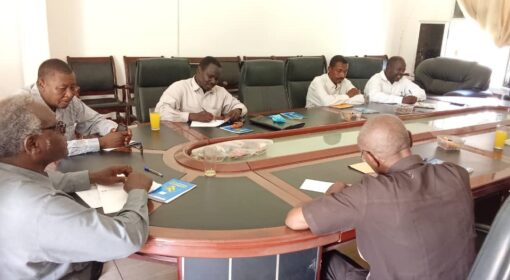
At more overarching level, a municipal steering committee was established. It will include the Prefect (government-appointed administrator), decentralized state technical agents (especially agriculture and environment), a tiipaalga representative, and two representatives from each village committee. The role of the municipal steering committee is clearly defined:
- Monitor what is happening across villages
- Connect community priorities with state programmes and initiatives such as Faso Mêbo
- Provide technical advice on issues like roads, water infrastructure, or land restoration
Crucially, this committee does not decide what communities should do. It acts as an arbiter and connector, not a substitute for local leadership.
APIL: working through CVDs and village assemblies
APIL took a different starting point. It works in five villages and initially planned to build on a women’s climate alliance and a farmers’ union. After reflection, the team concluded that a truly community-led approach needed to go through the village’s main governance body.
APIL, therefore, grounded RtF in the Village Development Committee (CVD). Unlike thematic groups, the CVD has a broad and recognized mandate for local development. It became the project management committee for RtF.
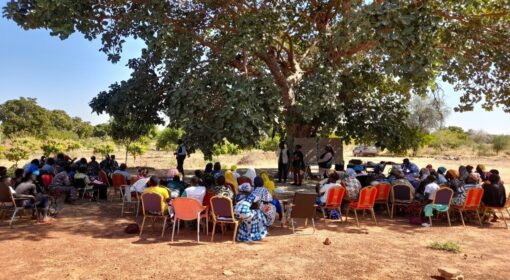
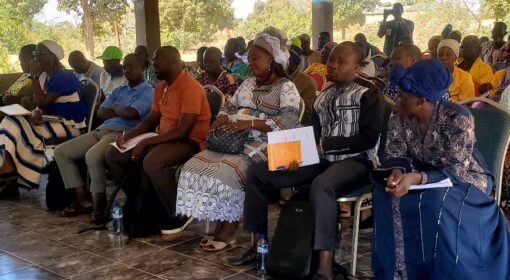
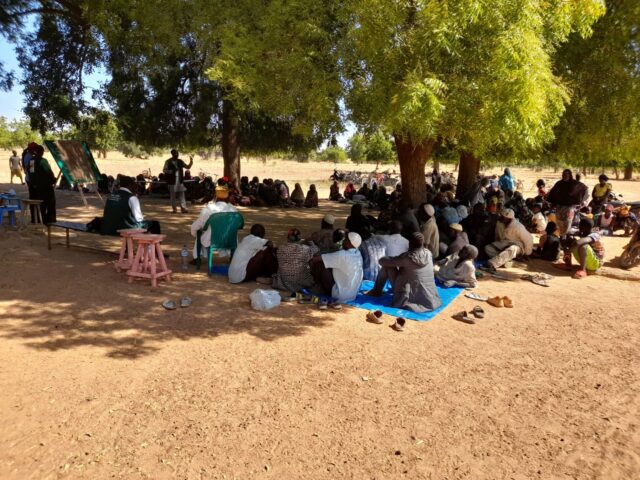
The process began with existing communal development plans (PCP). These documents were not accepted as static. APIL facilitated village assemblies where men, women, and youth confirmed or adjusted the listed needs, then prioritized them. Focus groups for different social groups fed into a shared list that the General Assembly could validate.
Two governance elements are central in APIL’s model:
- The CVD office as the core decision-making body
The CVD develops project documents based on community priorities. To avoid perceptions of capture, all major decisions and documents are discussed and validated in village assemblies. This keeps the CVD answerable to the wider community. - The Village Market Allocation Committee (CVAM)
Each village forms a CVAM with representatives of women, youth, elders, people with disabilities and others. The CVAM identifies the companies or service providers to carry out the work. Its proposals go back to the CVD, then to the General Assembly for approval, and only then to APIL for final checks such as solvency and compliance.
A practical challenge emerged: many CVDs had not updated their leadership, which complicates opening or renewing bank accounts. APIL is now working with communities to regularize CVD offices and, if needed, temporarily channel funds through cooperative accounts that include CVD members, respecting OHADA rules and strict due diligence. This is governance in motion, adapting to real institutional constraints without bypassing local structures.
Shared principles beneath different designs
The two hubs do not use identical models, yet their governance choices rest on the same principles:
- Build on what exists, do not replace social organization: Both hubs start from existing structures and processes. The aim is to make them more inclusive and effective, not to create parallel systems.
- Keep representation real, not symbolic: Committees are formed in ways that reflect neighbourhoods, women, youth, and vulnerable groups. The process of nomination and validation is as important as the structure on paper.
- Use higher-level bodies for support and alignment, not control: Municipal steering in tiipaalga’s case, and service agreements in APIL’s case, are designed to provide technical backing and policy links, while leaving decision power in the village.
- Let communities define beneficiary selection: Both hubs deliberately anchor selection criteria in local knowledge of who is vulnerable, who already plays which roles, and which activities benefit the whole community.
To conclude: LLA is not only about giving money to local actors or inviting them to workshops. It is about who sits where in the decision chain, how they are chosen, and how they remain accountable to the people most affected.
Community Governance is the quiet backbone of RtF in Burkina Faso. When it is inclusive, legitimate and well-connected across levels, locally led adaptation has a chance to last.