By Emdadul Haque (Uttaran), supported by Mst Jannatul Naim & Femke van Woesik (GOPA)
This blog is part of a dossier on locally-led adaptation, featuring insights and lessons from the Reversing the Flow (RtF) program. RtF empowers communities in Bangladesh, Burkina Faso, Ethiopia, Kenya, and Sudan to build climate resilience through direct funding and a community-driven, landscape approach.
Jugipota Unnayan Songothon (Landscape Management Committee), representing the Jugipota community of 178 households, began participating in the Reversing the Flow (RtF) programme in late 2024.
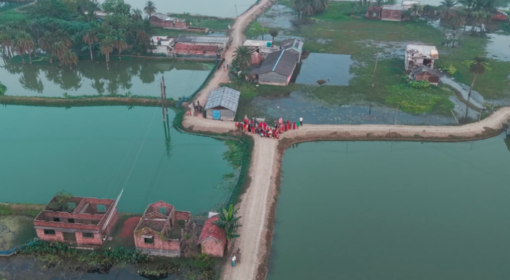
The community is located in a wetland area, about five kilometres away from the Satkhira–Assasuni highway. The access road that has to serve Jugipota and neighboring communities (total 1000 households) is in poor condition.

Next to poor roads, the community faces waterlogging, a lack of drinking water, and limited livelihood opportunities. A narrow, approximately two-kilometer canal once connected Jugipota to the Betna River and drained water from the area. Over time, the water flow stopped, and parts of the canal on government-owned Khas land were occupied by local powerful people.
Before joining RtF, community members repeatedly submitted applications to the Bangladesh Water Development Board (BWDB), the Member of Parliament (MP) and the Upazila Nirbahi Officer (UNO) requesting road repairs. They also approached local influential people and political leaders, but their efforts did not lead to a solution.
Under the RtF programme, the community had already implemented landscape restoration activities and identified road repairs and canal re-excavation as priorities. This time, with the Uttaran Hub’s facilitation, community representatives tried again to secure a direct meeting with the local MP. They discussed their challenges and shared details of their other RtF activities they are implementing to improve local conditions. Then they requested support for larger, high-cost initiatives like road repair and canal excavation, which are under government jurisdiction, making government support essential to address these challenges.
The MP committed to engaging BWDB and the Local Government Engineering Department (LGED) and called for the necessary assessments and actions.
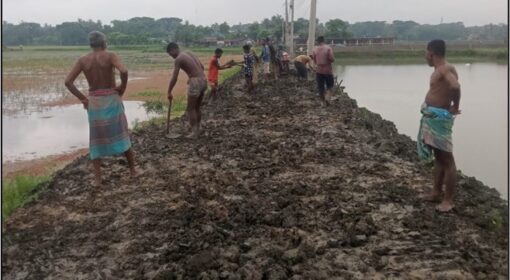
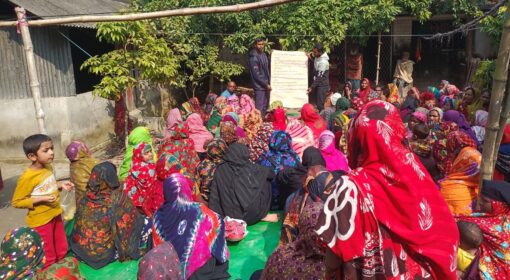
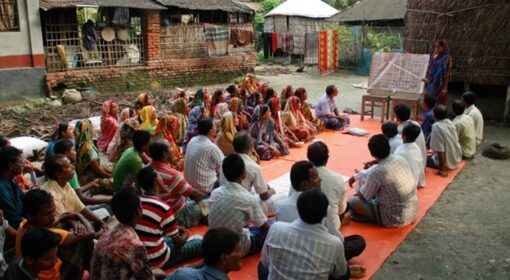
On 11 August 2026, the MP visited Jugipota and attended the organization’s annual meeting. After observing the community’s work and listening to a presentation by women, he praised their efforts. He also instructed the local BWDB technical team to take action as early as possible. Very soon, the approval letter for a work order was issued for BDT 4,193,830 (~29,700 EU), directing LGED to take steps to repair the 3.315-kilometre road, and BWDB did its initial technical survey and measurement of the canal for re-excavation. The visit was also reported on a local Bangla news channel (https://bartabazar.com/news/340188/)

Once re-excavated, the canal is expected to improve drainage and support rice and fish cultivation across around 500 hectares of land area used by Jugipota and the three neighboring communities. The community also plans to plant trees along the canal bank. These road repairs are expected to improve access to education, healthcare, and markets, and support local businesses and livelihoods. The community also hopes to plant trees along the road and improve its water inlets and outlets, contributing to a greener road and wetland restoration.

Jugipota’s story shows what changes when a community controls its own money. Through RtF, the LMC received funds directly and decided for itself how to spend them. That gave it something years of petitions never had: visible results. Before RtF, local elites had blocked the community’s requests. This time, its representatives came to the MP with restoration work already underway, priorities documented and women ready to present what they had achieved. The MP met an organised community with a track record, and government money followed. The result reaches well beyond Jugipota. A repaired road and a working canal will serve around 1,000 households across four communities, and local people are earning wages on the road works. More importantly, the community now has a seat at the table where local development is planned and funded. Direct funding gave Jugipota the standing to make its case, and it used that standing to bring public investment to an area that had long been passed over. When external programmes put money and decisions directly in community hands, a modest grant can open the door to far larger public investment.