By NGOs APDA & ORDA, supported by Nardos Masresha and Femke van Woesik
This blog is part of a dossier on locally-led adaptation, featuring insights and lessons from the Reversing the Flow (RtF) program. RtF empowers communities in Bangladesh, Burkina Faso, Ethiopia, Kenya, and Sudan to build climate resilience through direct funding and a community-driven, landscape approach.
Development projects often arrive with good intentions and technically sound interventions, trenches, seedlings, boreholes, and grants. But technical input alone rarely produces lasting change. What transforms a one-off activity into durable environmental restoration and ongoing livelihood improvement is embeddedness: intentionally working through and strengthening local governance through the kebele-level bylaws, community institutions, customary rules, and accountability practices that already shape everyday life.
The local NGOs ORDA Ethiopia in Koti Kebele, and APDA in Chifra and Adaar Kebeles offer a clear example. Instead of imposing parallel management structures, through RtF they supported the formation and empowerment of watershed user committees, helped communities draft working manuals and internal bylaws, and channeled most of the grant money through community-managed mechanisms, with measurable restoration, financial accountability, and livelihood gains.
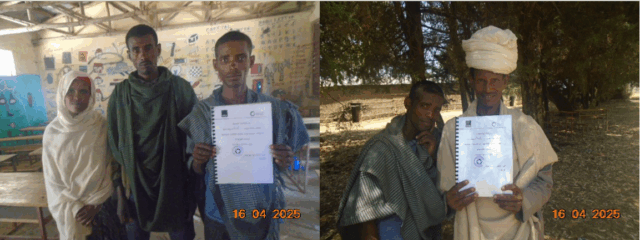
WUA leaders holding Memorandum of understanding signed with ORDA Ethiopia (Photo by ORDA Ethiopia)
How CBO/Watershed User Association bylaws and customary rules function at kebele level, where local governance is often a blend of formal and customary systems:
- Bylaws and manuals: community-based organizations (CBOs) and committees typically adopt written internal bylaws and operational manuals for finance, procurement, revolving funds and property administration. These documents set membership rules, leadership election procedures, decision-making thresholds, eligibility for benefits and loan criteria. RtF-supported watershed committees in Koti Kebele in consultation with ORDA Ethiopia prepared exactly these kinds of manuals and used them to guide procurement and revolving fund distribution. For example, the watershed users’ internal bylaws stipulate that every user must contribute labor to natural resource management, water supply, irrigation, and other related activities. Similarly, the procurement manual specifies that for purchases exceeding ETB 200,000.00 the executive committee must invite at least three suppliers to submit pro forma invoices. However, when the suppliers are government entities, unions, or related organizations, direct procurement from a single supplier is permitted.
- Customary rules and norms: Informal norms govern resource access, labor obligations (e.g., community soil-and-water conservation works), and conflict resolution. Elders, religious leaders and customary institutions frequently arbitrate disputes and enforce sanctions. These practices carry social legitimacy that external project staff rarely possess.
- Kebele administration linkages: Kebeles (the lowest formal government unit) provide civic recognition, security, and technical oversight. Where committees align with kebele structures, they benefit from formal legitimacy and administrative continuity.
Together, these written and unwritten systems create a practical operating environment for collective action:
- Legitimacy through familiar rules: When committees operate under bylaws and customary norms that members themselves have created and agreed upon, their decisions gain immediate acceptance, reducing friction and resistance. This reduces friction and resistance. RtF communities used the bylaws and simple community monitoring to build trust and transparency, trust that in turn enabled larger responsibilities like procurement and loan-making.
- Ownership by design: Embedding roles and criteria in locally crafted bylaws gives people a real stake: they define beneficiaries, set loan eligibility, and approve plans. Ownership becomes procedural, not rhetorical. RtF’s approach, technical training, knowledge exchange with community members, electing watershed users’ committees, and presenting plans for community approval, shifted power and increased follow-through.
- Accountability that fits social reality: Local accountability mechanisms (regular review meetings, monitoring, bi-annual reporting to the community, customary oversight) are low-cost and culturally understandable. RtF committees used observation, monthly review meetings, beneficiary interviews, and simple reports to hold each other accountable, a system that was cost-effective and built local capacity to manage funds. (See also this blog)
- Continuity after the project ends: Committees that manage revolving funds, maintain office space, and run seedling nurseries under locally approved rules are more likely to sustain actions. RtF’s re-grant approach (most funds passed to committees) and the committees’ continued loan practices helped sustain natural resource management and livelihood activities beyond short-term inputs.
What this implies for program design: – practical principles
- Don’t build parallel systems: Parallel monitoring, procurement or beneficiary-selection structures duplicate effort and undermine local institutions. Instead, map existing governance and adapt project procedures to fit local bylaws and customary processes.
- Invest early in locally owned rules: Support communities to draft clear, simple bylaws and manuals (finance, procurement, revolving fund management). RtF’s early work in preparing these documents and training committee members paid off in transparent local procurement and loan administration.
- Use re-grants and delegated authority: Where feasible, channel funds through community-managed grants and give committees real decision-making power (within clearly agreed limits). This creates incentives for performance and builds local capacity, as RtF demonstrated when committees independently implemented plans and managed re-granted funds.
- Design for accountability that communities can run: Replace heavy external M&E with community-led monitoring: periodic community review meetings, monitoring, simple beneficiary interviews, and public reporting. These methods are cheaper, culturally appropriate, and build local capacity.
- Plan for inclusion and gendered power dynamics: Bylaws must explicitly require inclusive representation and clear mechanisms for women, elderly and disabled persons to access benefits. RtF noted low female participation as a challenge; programs must budget for targeted empowerment and support.
- Provide technical, not managerial, hand-holding: Communities value technical guidance (soil & water conservation, borehole maintenance, budgeting skills) rather than top-down management. Offer training and on-demand support rather than replacing local decision-makers.
- Build legal and administrative bridges: Where customary rules conflict with formal regulations, facilitate dialogue among kebele officials, customary institutions and CBOs to harmonize bylaws and ensure continuity once external funding declines. Elders play a key role in resolving conflicts through mediation and truce. For example, while formal regulations state that a person who fails to implement soil and water conservation measures on private land may lose their land through a court decision, in practice, local elders or watershed committees address such cases through dialogue, advice, and enforcement of community bylaws without referring them to the courts.
Similarly, although formal regulations prohibit the use of land with slopes greater than 30% for crop cultivation, this rule is not strictly enforced at the local level. Instead, such lands are often cultivated, with community by laws requiring farmers to at least construct appropriate soil and water conservation structures.
Finally, embeddedness is a practical route to resilience. When restoration and adaptation activities are designed to sit inside local rules, accountability practices and administrative rhythms, they are more likely to be legitimate, adopted, maintained, and scaled. ORDA’s RtF experience shows the payoff: empowered watershed user committees, transparent local finance practices, restored landscape and livelihood investments, all outcomes that came from working with, not around, local systems.