By Shadi Indary, Farah Kamaleddine, Zeina Mahmoud and Luwieke Bosma
Introducing a new agricultural practice is one challenge. Ensuring that it continues to grow long after a project ends is another.
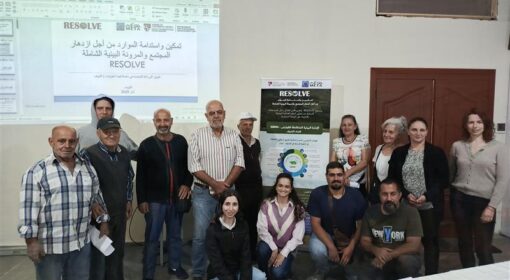
Building on the lessons and momentum generated during RESOLVE, a project that introduced Ecologically-Based Rodent Management (EBRM) to farming communities in Lebanon, the newly launched LOCAL-STEP project is now taking the next step: scaling up EBRM to reach more farmers and strengthen local stewardship over natural resources across the Shouf region.
Background and Context
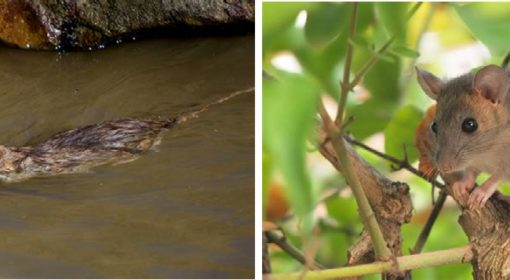
Rodents are among the most widespread and adaptable mammals globally. For farmers, this is not just a nuisance. Rodents can damage crops in the field, affect stored harvests, and create risks for public health and the environment. Conventional control approaches, particularly chemical rodenticides, are often insufficient or unsustainable because of concerns around resistance, safety, and impacts on wildlife and ecosystems.
In response, Ecologically-Based Rodent Management (EBRM) offers a different way forward. EBRM brings together ecological knowledge of rodent behaviour, population dynamics, farming practices, local conditions, and environmental factors.
In Lebanon, EBRM initiatives are still limited, but interest is steadily increasing. The onset of EBRM in Lebanon was first laid through the RESOLVE project.
The EBRM pilot under RESOLVE focused on understanding rodent diversity and population dynamics in both polycultural and monocultural lima bean systems, designing and testing a locally adapted methodology for small-scale farming, evaluating the effectiveness of EBRM in reducing rodent abundance and crop damage, and building farmer capacity for non-chemical rodent management. This proved important lessons:
- Demo-plots on farmers’ fields showed how the approach works under local conditions. Through trial and adaptation, co-monitoring and observing the results, a new approach gains credibility.
- The process revealed big gaps in the provision of information from extension services, and a lack of non-chemical rodent management products from input providers.
Building on the results and lessons from RESOLVE, the work now continues through the LOCAL-STEP project — Local Stewardship for Enhanced Resource Management and Resilient Livelihoods in the Shouf Region. LOCAL-STEP aims to scale previous findings on effective EBRM methods and promote wider adoption of locally rooted agroecological practices. Importantly, this scaling is not limited to farmers only. Alongside continued collaboration with farmer clusters, LOCAL-STEP also strengthens cooperation with agricultural extension services, input providers, local authorities, and policymakers.
This marks an important step to move on with the agroecological transition. Demonstration at field level is essential, but it should not remain isolated. At the same time, scaling should not move ahead without being grounded in practical farmer experience. For EBRM to become part of regular agricultural practice, both need to move together: strong field evidence and wider institutional uptake.
The Value of Local Championship and Sustaining a Community of Practice
Within this broader effort, the role of committed individuals is crucial. Through the EBRM Community of Practice, active through a WhatsApp group, farmers regularly share their daily trap catches, discuss challenges encountered in the field with the ecological expert, exchange practical solutions, and encourage one another throughout the implementation process. The success of project activities is closely linked to proactive farmers who are willing to test, adapt, and share what they learn. One example is Mr. Loqman Ghaith from the village of Bater, Shouf District.
Although Mr. Loqman Ghaith joined the project after the initial awareness activities had taken place, his enthusiasm quickly transformed him into one of the most engaged EBRM practitioners in his village. Rather than simply following instructions, he approached EBRM with curiosity and determination. He tested different bait combinations, experimented with trap placement, adjusted techniques based on field observations, and continuously searched for ways to improve his results under local conditions. With that, Mr. Loqman was able to protect his pomegranate harvest for the 2025 season.
❝Every year, I lose part of my fruit harvest because I refuse to use pesticides. I know I have to use pesticides, but I always postpone it because I dislike using them. With all the pollution we already face today, reducing our reliance on pesticides is very important.❞ — Mr.Loqman Ghaith, Farmer from Shouf, Lebanon
His engagement did not stop there. Under LOCAL-STEP, Mr. Loqman has become even more active, supporting implementation and helping to introduce the EBRM concept to other farmers in his neighborhood. His field experience has made him a practical reference point in his community. Several farmers were convinced by observing the approach in practice, hence transitioning to EBRM with the necessary logistical and technical support from the project team. Below is an example of Mr. Loqman’s messages on the Community of Practice group:
❝We hope our fellow farmers will start deploying the traps early. The earlier we begin, the greater the benefits. Starting early makes the whole process more effective and helps reduce problems throughout the season, whether in pomegranates, beans, or any other crops. Rodents of this size [medium to large, as shown in the video] have no mercy—they will eat everything, whether it’s green or ripe❞

Scaling beyond the project
As LOCAL-STEP expands EBRM to new communities, one lesson remains clear: sustainable scaling is built through local ownership.
Mr. Loqman’s experience illustrates how local champions can strengthen a wider adoption of a new practice. They help demonstrate that EBRM can work under real farming conditions, encourage peer-to-peer learning, and provide feedback that continuously improves the approach.
❝ Thank you for your work last year and this year. This is a wonderful initiative. It has helped reduce the damage to our crops in a natural way that is safe for both farmers and the environment. ❞ — Mr.Loqman Ghaith, Farmer from Bater
The ongoing experience in Lebanon is a proof that local capacity is built through relationships and evidence, and by involving institutions that can help carry the approach further. In this way, LOCAL-STEP builds on the foundations laid by RESOLVE: moving from pilot testing to broader adoption, while keeping farmer experience at the centre.