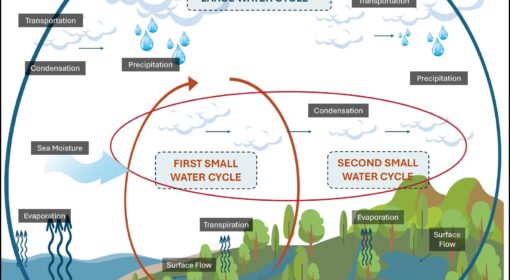
Irrigation sustains nearly half of global food production and supports the livelihoods of billions, while accounting for around 70 percent of global freshwater withdrawals. As the irrigated area has expanded almost sixfold over the past century to approximately 3 million square kilometres, irrigation has become the largest human intervention in the water cycle and a major force within the Earth system, altering both land energy balances and hydrological processes.
How global water resources are managed, how water scarcity is addressed, how food availability is secured is therefore closely linked to how irrigation systems are designed, operated, and governed. As land use change and degradation increasingly disrupt local water cycles, irrigation’s role in restoring and stabilising these cycles moreover becomes central to climate resilience and water security. Irrigation must be rethought as part of the broader water cycle rather than solely as a means of supplying water to crops.
However, irrigation is managed below potential in many countries. Water use keeps increasing, often depleting strategic groundwater reserves and compromising environmental flows, while crop yields show only marginal improvement.
This paper sets out GOPA MetaMeta’s perspective on the future of irrigation system management, highlighting the:
- Challenges
- 7 Principles for Improving Irrigation System Management
- Solutions and Service
It is grounded in decades of practical experience in large-scale and smallholder irrigation, drainage, land and water management, and climate adaptation across Africa, Asia, Europe, and the Middle East.
Drawing on field practice, applied research, and system-level advisory work, the paper reframes irrigation as critical public infrastructure within the wider water cycle. It outlines the core challenges facing irrigation systems today and proposes a set of principles and practical pathways to improve performance, resilience, and governance under growing climate pressure.
This position paper is intended to inform governments, development partners, irrigation authorities, and financiers seeking integrated, implementable solutions that go beyond isolated technical upgrades.
You can access the full paper here.