By Frank van Steenbergen and Letty Fajardo Vera

Postcard from the Dreieck, Koblenz, where two big rivers meet – the Moselle and the Rhine – with the Moselle joining the Rhine River at Dreieck (triangle), dated 30 September 2026.
An almost empty boat in the middle of the Rhine River, and after a while, another one. Not more than one or two boats an hour in what is normally a major shipping artery. Here are the record drought and heat at work that have affected Germany and large parts of Europe this year. This dramatic rainfall shortage – with rain less than 50% of a normal year and no drop for six months in the Rhine catchment – follows from the dress rehearsal in 2022, when rainfall was 40% less. This year the temperatures moreover were also 3-4 degrees above average, manifesting also in a string of heat wave days. And add to this the long-term trend of declining snowfall in the Alps.
In the lower part, the Rhine River now runs at one-third of its official discharge. Upstream of Dusseldorf, shipping is difficult on the normally mighty river, and further upstream at the Koblenz Dreieck and above the Rhine River is hardly navigable. On the riverbank the normal water marks are painted: the few boats that sail sail below the official water mark, painted on the riverbank. This is how much the water level has dropped – 3 to 4 more meters, the freeboard of the ships.

It is all chips down. The Rhine river system derives its water from three sources – the snowmelt from the Alps, the rainfall in its catchment and the groundwater base flow. When the Rhine is high, it feeds the aquifer along its banks, and when the river flows at low level, these aquifers provide the river with groundwater.
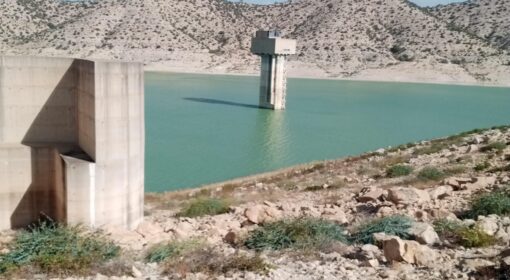
At the Dreieck the Moselle joins the Rhine, normally contributing one-tenth of the discharge. But not this time – there is no outflow from the Moselle, and the water coming out over the last weir at the Moselle is just a trickle (see top photo). The Moselle is a largely rain-fed river dependent on the rainfall in the catchment. But there has been no rain for months now. The rain deficit has been 70% this year.
The flow in the Moselle fell dramatically – to almost zero. It caused the water authorities to change the operation of the river: they have turned the river into a lake. The Moselle has four weirs cum ship-locks built in the past, to ensure a steady flow at navigable depth. The weirs and locks have now assumed a different role – to retain all the water that is in the river behind them, not letting any water escape from the Moselle, effectively transforming the river into a long winding reservoir with almost zero flow. Unlike the Rhine, the groundwater base flow in the Moselle is much smaller – below 10 all because of the slate geology, which does not allow for aquifer systems with much capacity for storage.

With the water largely stagnant, algal blooms spiralled, turning the Moselle into a long green water body. With this comes a major health risk: especially the blue algae are bound to produce cyanide bacteria that can even be lethal.
The major repercussion is economic. With navigation winding down, goods and commodities have had to be shifted to road and rail transport, adding enormous costs, running into billions and shaving at least 0.3% of Germany’s GDP.
A huge wake-up call and more than an incident. Climate change is transforming the river systems – driven by less snow, less snowmelt, stagnating rain, and less recharge. Also, the groundwater outflow that now sustains the low river flows is affected. Groundwater stocks are depleting due to the low river flows, and if it lasts multiple years, there will be less base flow to even provide the minimum discharge of the river. Then also glaciers and snowfields in the Alps have shrunk – further chipping away at buffer capacity when it is needed most.
It is time for change, to revisit navigation – deepening shipping lanes and rethinking boat shapes – wider and shallower. It is also time to rethink water management in the entire catchment, creating more multiyear storage in the catchments and the aquifers, for instance, retaining water and snow by many measures. It is also time to understand the small water cycles that transport and recycle moisture and increase precipitation in the Alps and the entire Rhine and Moselle catchment by a delicate placement of water bodies and forested areas and a reconsideration of agricultural and urban land management practices.