By Arpan Mondal, Pratik Ranjan, Shubham Jain and Meghan Mukerjee, GOPA MetaMeta
In the farming villages of Jharkhand and Madhya Pradesh, rodents have always been part of life. Farmers talk about them the way they talk about rain or drought – unavoidable, destructive, and out of their control. Crops disappear quietly at night, grain stores get damaged, and bunds collapse, but no one really knows how many rats are there or where they are coming from.
Under the Productive Biodiversity – Ecologically Based Rodent Management (EBRM) initiative[1], local farming communities decided to ask a different kind of question. Instead of spraying poison or setting random traps, we asked: what if we first counted the rats?
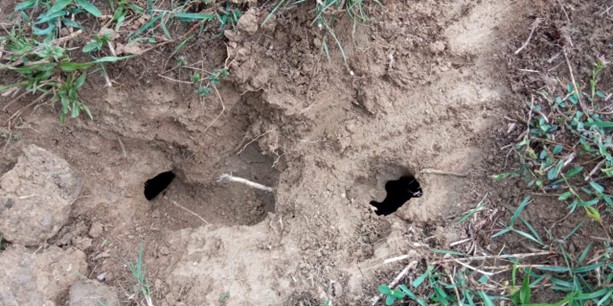
The question quietly shifted the direction of the conversation. Farmers who were used to talking about damage began thinking about numbers. How many burrows are there? Which fields are most affected? Is the problem the same everywhere?
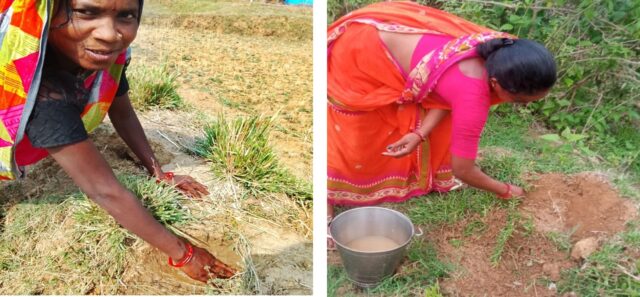
With facilitation from GOPA MetaMeta, this line of thinking gradually moved from discussion to action. Farmers began walking through their own fields, not looking at crops, but looking at the soil. Every small opening, every burrow, every tunnel made by rodents was marked and sealed with mud. What began as a question turned into a practical, field-based activity. In 7 villages of Jharkhand and Madhya Pradesh namely Kherbani, Ranabandh, Badadumarhill, Mahuatand, Durgapur, Dudhera & Paudi for instance, across 125 farmers and nearly 58 acres of farmland, more than a thousand rat burrows were recorded. Many farmers were stunned. They had always known rodents were a problem, but seeing their invisible world mapped so clearly changed how they understood the scale of damage happening beneath their feet. They did not just count the burrows, tney also sealed them with soil.
One week later, the farmers returned to the same fields. What they found was both fascinating and disturbing. More than 50 percent of sealed burrows had been reopened. Fresh soil was scattered around the holes, and new tunnels had appeared. Out of 937 sealed burrows, 474 were active again. In simple terms, more than half the rat families in these landscapes were alive, moving, feeding, and damaging crops every night.
The data also revealed something unexpected. Rodent pressure was not the same everywhere. In Jharkhand, especially in places like Godda and Dumka, the number of active rat burrows was extremely high — often more than 15 per acre. In some villages, like Badadumarhill in Godda, there were close to 60 active burrows in a single acre. In contrast, farms in Madhya Pradesh showed far fewer rat holes, sometimes as low as two or three per acre. What farmers had felt for years — that Jharkhand was suffering more — now had scientific proof.
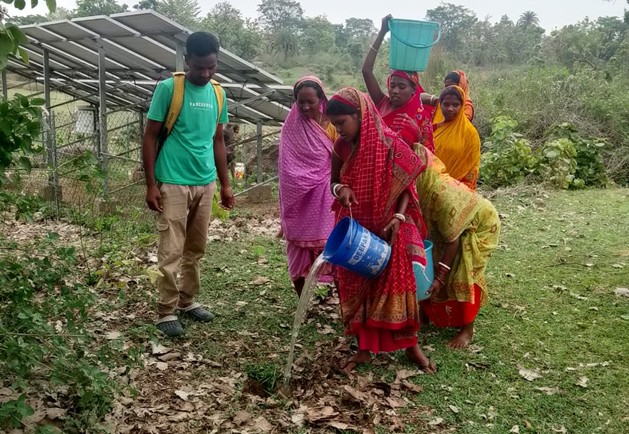
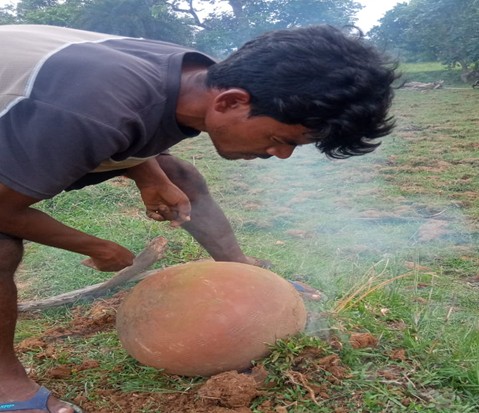
But the most important part of this story was not the numbers. It was what farmers did with them. Once the active burrows were identified, communities came together to act. Every reopened hole was fumigated and flooded. No one said, “This is not my field.” Rodent management became a collective responsibility, not an individual struggle.
This is what makes Ecologically Based Rodent Management different. It is not about killing rats indiscriminately. It is about understanding where they live, how they move, and how the farm landscape itself supports or controls them. When farmers know where the pressure is highest, they can decide where to place bird perches, where hedges are needed, and where water management can disturb burrow systems. EBRM turns pest control into ecological intelligence.
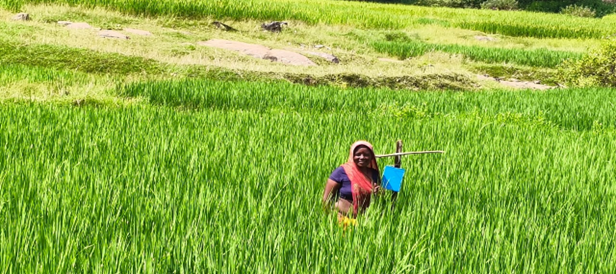
What began as a simple exercise of counting and sealing burrows ultimately led to a measurable reduction in rodent pressure across the intervention villages. Following coordinated action on active burrows, farmers observed fewer fresh holes, reduced crop cutting, and lower grain losses in the weeks that followed. Field estimates suggest that approximately ₹74,000 worth of crop damage was prevented across the seven villages combined, with average savings ranging between ₹700 and ₹1,200 per farmer during the intervention cycle. The burrow count did not eliminate rodents entirely, but it transformed how communities respond to them — shifting the problem from something inevitable to something manageable through informed, collective action.
[1] Supported by Rijksdienst voor Ondernemend Nederland (RVO) and implemented by Gopa MetaMeta.