By Abebaw Zeleke – ORDA Ethiopia
This blog is part of a dossier on locally-led adaptation, featuring insights and lessons from the Reversing the Flow (RtF) program. RtF empowers communities in Bangladesh, Burkina Faso, Ethiopia, Kenya, and Sudan to build climate resilience through direct funding and a community-driven, landscape approach.
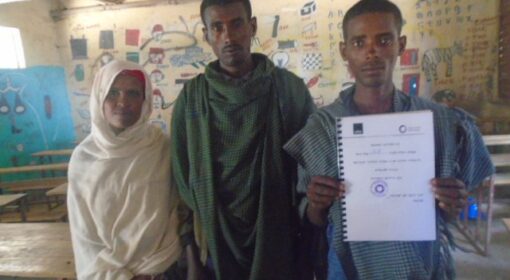
Mr. Manchalaw Walelign, 49, lives with his family of three in Adafit micro-watershed, Koti Kebele, Yilmana Densa Woreda, North Gojam Zone, Amhara Region. His livelihood depends on subsistence farming, mainly crop production. He first learned about the Reversing the Flow (RtF) project’s livelihood improvement activities during a community meeting.
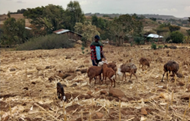
In June 2024, Manchalaw received a loan of ETB 30,000 from the project. He added ETB 6,000 from his own savings and purchased four mother sheep for a total of ETB 36,000. After six months, he sold four lambs born from these sheep for ETB 25,000, generating a good income.
Encouraged by this progress, in January 2025, he bought two additional sheep for ETB 16,000 using the income he generated. These four mother sheep are currently pregnant, and he expects more lambs in May.
With the remaining profit, he was able to address key household needs. He bought clothes for his children and wife, paid for health insurance, and covered income tax for his small plot.
Manchalaw prefers sheep rearing because it is manageable for his family using a cut-and-carry feeding system at home. He also benefits from veterinary extension services available in his kebele.
“I was struggling to get start-up capital for sheep rearing. I tried to borrow from neighbors and informal lenders known as ‘Arata,’ but the interest rates were too high and not profitable for me.”
Now, he is not only improving his livelihood but also encouraging others:
“I advise my neighbors that sheep rearing is a profitable activity. I encourage them to take loans from the project and start their own. My family and I are happy—our life has improved, and our hope has expanded.”
He also appreciated the RtF locally led adaptation approach, noting that the re-grant fund is managed locally, making access to revolving loans quick and free from bureaucracy. Importantly, the community defines the criteria for selecting beneficiaries, ensuring fairness and transparency.
He expressed his gratitude to the RtF project for supporting his livelihood. He also hopes the project will continue its efforts in improving water access and land rehabilitation, and expand its support to other micro-watersheds in Koti Kebele.
Finally, a small revolving fund made it possible to change the family’s life.