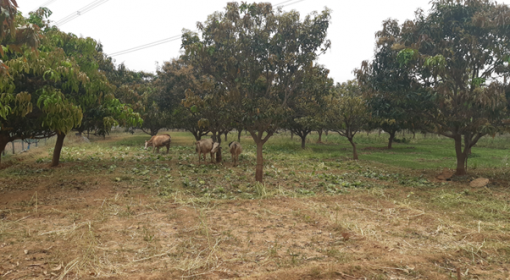
By Abebaw Zeleke – ORDA Ethiopia
This blog is part of a dossier on locally-led adaptation, featuring insights and lessons from the Reversing the Flow (RtF) program. RtF empowers communities in Bangladesh, Burkina Faso, Ethiopia, Kenya, and Sudan to build climate resilience through direct funding and a community-driven, landscape approach.
Adafit micro-watershed
Adafit micro-watershed is found in Koti Kebele, Yilmana Densa District, in North Gojjam Zone of the Amhara Region. It covers 370 hectares and is home to 335 households, including 74 female-headed households. The land includes farmland, grazing areas, shrubland, and settlements.
The Adafit micro-watershed has been severely affected by gully erosion, land degradation, deforestation, and uncontrolled free grazing. As a result, farmland and settlement areas were damaged, crop yields declined, homes were threatened, and local roads deteriorated. These challenges made it difficult for the community to sustain their livelihoods and live securely.
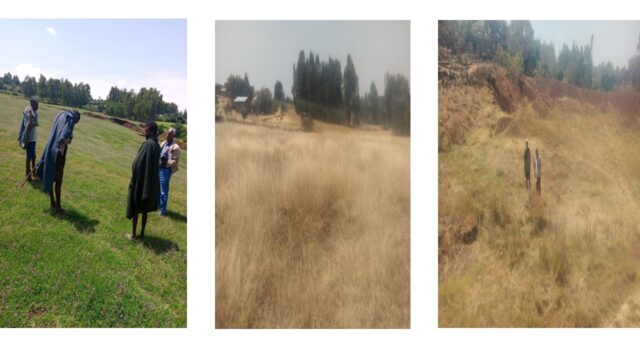
With the introduction of the locally led approach by the RtF project, community members were mobilized and jointly planned to rehabilitate 8 hectares of Muchit-Wuha degraded communal grazing land in June 2025. The community agreed to ex-close and restore the degraded land, and improve their livelihoods.
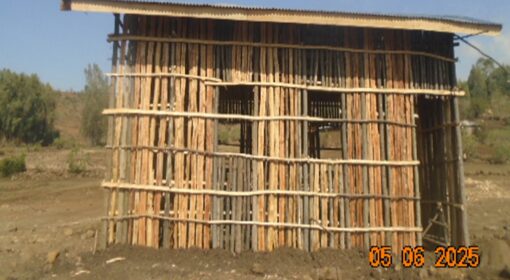
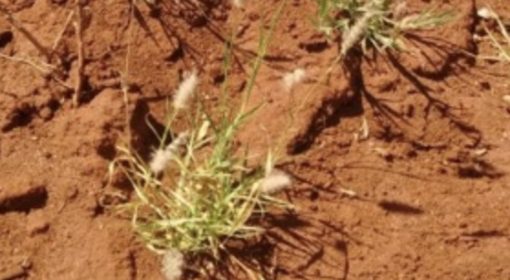
The community that led this work closed the area to human and livestock interference. They constructed soil-filled sandbags and wooden check dams to control gullies. During the 2025 rainy season, they planted tree seedlings. They also sowed forage and fodder seeds such as Sesbania, Lupin, Vetch, and Rhodes grass. Elephant grass was planted as well.
The community received small grants from ORDA Ethiopia. They bought tools, seeds, and seedlings. Technical support was also provided. But key decisions remained with the community. They selected species based on local knowledge and need. This strengthened their confidence and ownership.
The land is now recovering. Vegetation is returning. The survival rate of seedlings reached 83%. Local trees like Croton, Combretum, and Acacia abyssinica are regenerating. Grasses and herbs are growing again. Soil erosion has reduced. Downstream farms and settlements are better protected from floods.
Community Reflections
“We protected the land, and now we see change,” says Addis Tadesse. “Trees are growing back. Grass has returned. Soil erosion is reduced. We are benefiting.” The community is also thinking long term. “This year, we decided not to harvest grass,” says Manchalew Wallelign. “We want seeds to spread and make the land covered by denser vegetation.”
The ex-closure is now attracting life and has become a habitat for various insect species, such as bees, butterflies, and birds. The area is becoming productive again.
Besides, the community has also set local rules. They developed bylaws and formed a watershed user committee. They agreed on fair use of resources. This has reduced conflict and improved cooperation.
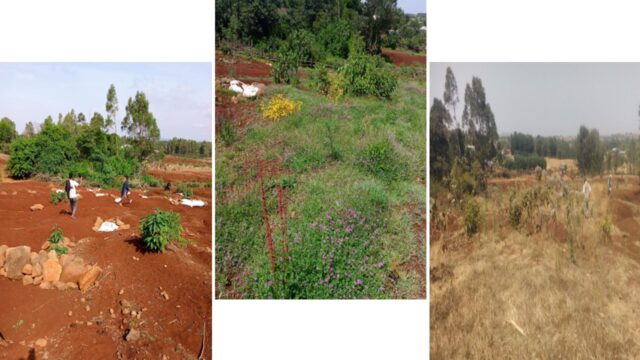
“We advise other communities to do the same,” says Addis Tadesse. “Ex-closure is simple and low cost. It needs agreement and commitment. Now we are seeing the result.”
Community members also value the approach. They made decisions. They managed resources. They led the process. This made the intervention more effective and sustainable. Today, Muchit-Wuha is changing. It shows that when communities lead, restoration is possible.