Frank van Steenbergen and Femke van Woesik
Is the world ‘water-bankrupt’? The recent UN-INWEH report “Global Water Bankruptcy: Living Beyond our Hydrological Means” presents a sobering case:
- The number of rivers that lose their discharge, even failing to reach the sea for parts of the years is on the increase. More than half of the world’s large lakes have lost water since the early 1990s,
- In the last five decades, we have lost a continent of wetlands – 410 million hectares, close to the size of Europe
- In the same period, 30% of the glacier mass has gone, unsettling the lives and economies of those living downstream of the mountain ranges
- 70% of the world’s major aquifers are in long-term decline. Uncontrolled groundwater extraction has already land subsidence in close to 5% of the global land area
- Roughly 70% of the global freshwater withdrawal is done to serve irrigation, but 170 million hectares of irrigated cropland are under high or very high
The point all these facts make is that wording this as a ‘crisis’ is too easy. On many fronts, we have lost the asset already. It appears that while we have been much occupied with global climate changes, water systems have been collapsing under our ward – by nothing else than uncontrolled demand, inability to act, and a pre-occupation with other and often trivial issues.
Bankruptcies’ sometimes lead to resets and restarts. It is not a given, but there may be three directions, all quick gestation, that provide some hope:
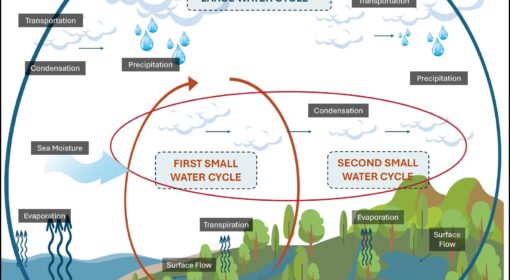
(1) Restoring the water cycles, starting with the smaller local water cycles. When areas are stripped of rich vegetation, rainfall patterns break down. It has been estimated that globally we have 20% less rainfall with this effect not distributed equally. Local water cycles can be restored – and often relatively rapidly. Land and water management, especially allowing forests to thrive, and knowing what to do where, can reboot rainfall systems
(2) Reimagining irrigation – as the Water Bankruptcy Report mention 70% of the water globally is used for irrigation. This is where the assets still lie, and breakthroughs are highly needed. There is much to gain in changing the way water is allocated within irrigation systems – which areas get what, how much, and how this is connected to crop water needs, groundwater recharge, and other functions. There are many examples of water obesity within irrigation systems, with areas receiving so much water that they drown in it and land and water productivity is suppressed. The World Bank has even mentioned that globally 125 million hectares (1) are unsustainable irrigated and required reduced water use – so clear rethinking water allocation in irrigation systems is a priority.
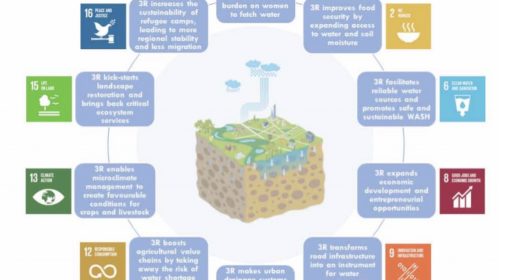
(3) Integrating water management in the entire management of making use of the entire landscape to manage water. There are, for instance, 40 million kilometres of roads in the world. These roads can all have a positive water function, with the different utilities in different geographies: groundwater recharge, spring development, water retention, flood control, and soil stabilization. What it takes is adding relatively small measures to the conventional practice of road building – water management practices that will, in most cases, also preserve the quality of the road.
There may be more openings, but what is clear we need to move to another mode of combat. The report also makes the point that we need a different agenda. The water agenda has been dominated by WASH, IWRM, and efficient water use, but in the meantime, the fundamentals have gone. Another agenda is needed in the water sector and not only in the water sector: focus on tackling real challenges, not on tantrums, non-sense and skirmish political conflicts.