By Mst Jannatul Naim and Uttaran Team, Karen Stehouwer, Nardos Masresha, and Zare Aida
…………………………………….
This blog is part of a dossier on locally-led adaptation, featuring insights and lessons from the Reversing the Flow (RtF) program. RtF empowers communities in Bangladesh, Burkina Faso, Ethiopia, Kenya, and Sudan to build climate resilience through direct funding and a community-driven, landscape approach.
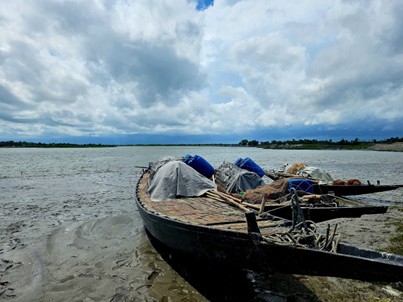
In coastal Bangladesh, where cyclones, salinity, waterlogging, and poverty overlap, development means navigating complex, layered realities.
One of the lessons from Uttaran’s work under the Reversing the Flow (RtF) programme is that locally-led processes take time, patience, and flexibility: not because communities lack capacity, but because they are doing something genuinely different. Rather than implementing plans designed elsewhere, communities are analysing their own vulnerabilities, setting priorities, managing resources, and making decisions that reflect their actual lives. That shift takes time to build. And it is worth it.
Ownership changes everything
In conventional development projects, activities begin quickly because plans are fixed in advance. Locally-led adaptation works on a different logic. The process starts slower because communities, not external actors, are in the driving seat from the beginning.
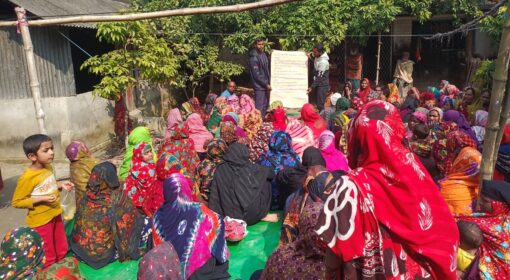
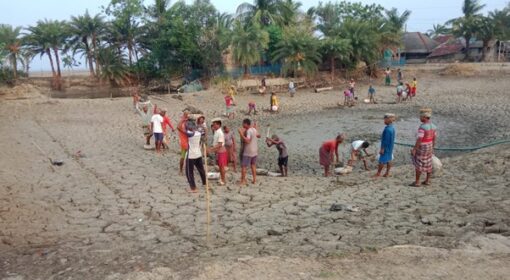
This is illustrated clearly by Mr. Golok Bihari Mondol, Vice President of the Jiala Salta Unnayan Committee in Satkhira, who explained why road renovation work had taken longer than planned: technical approval was needed from the local government, and the area had been underwater for much of the year. “Now that it is the dry season,” he said, “we expect to complete the remaining work within the next 10 days.”
His reflection shows how communities have clear, justified reasons behind delays and plan their work according to local conditions. Unlike many traditional projects, where activities may stop without a clear explanation, locally-led approaches inherently keep people informed and involved. This leads to more realistic planning, better timing, and stronger accountability.
Community is not a simple thing
To fully understand this shift, we need to rethink what we mean by “community”. In many conventional development approaches, communities are treated as a homogeneous group of people defined by religion, geography and common landscape problems, identified through surveys, focus group discussions, or desk-based analyses from available data sources.
However, RtF experience reveals that communities are far more complex. They have systemic structures shaped by layered vulnerabilities, differences in class, gender, disability, access to resources, and exposure to climate risks. What makes a community is not one story. Even within the same village, people experience climate risks differently. A landless farmer, a widow, a person with disability, and a local elite may all face the same flood or cyclone, but their actual exposure and ability to cope and recover are very different.
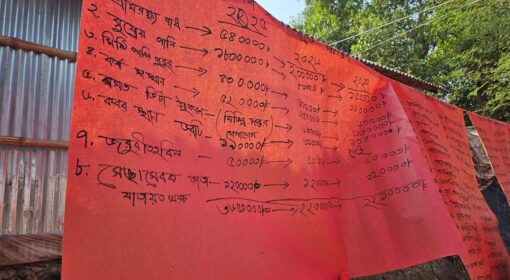
Locally led adaptation takes time because it tries to understand and include all these different realities. It creates space for communities to collectively unpack these differences, negotiate priorities, and ensure that those who are often excluded (women, persons with disabilities, the ultra-poor) are part of decision-making processes. However, this inclusion does not happen automatically. It requires time to build trust, shift local power dynamics, and ensure meaningful participation. This is one of the key reasons why the initial phase of locally-led processes often takes longer than traditional project implementation.
Flexible by design
So, is locally-led always slow? No, it is not. These same communities show a huge collective power to realize their plans at the right time at full speed. Because they see relevance as their priority, because they have planned it on a moment that it comfortable to them, but also because they don’t need to adhere to all kinds of bureaucratic procedures, while maintaining local accountability.
In contrast, traditional projects often operate within fixed plans and rigid logframes, where activities, timelines, and outputs are defined in advance and leave little room for adjustment. Flexibility is limited, not only in what is done, but in how and when it is done.
Locally led adaptation works differently because flexibility is built into the process itself. Communities can pause, reorganise, and resume work in response to changing conditions. This means that when RtF communities in Bangladesh included small income-generating activities for the most vulnerable alongside broader adaptation efforts, it was not a deviation from the plan: it was the plan responding to reality. Addressing immediate survival needs strengthened participation in collective action and deepened trust over time.
What initially looks like a delay is often strategic pacing: communities moving at a rhythm that makes outcomes more relevant, more durable, and more theirs.
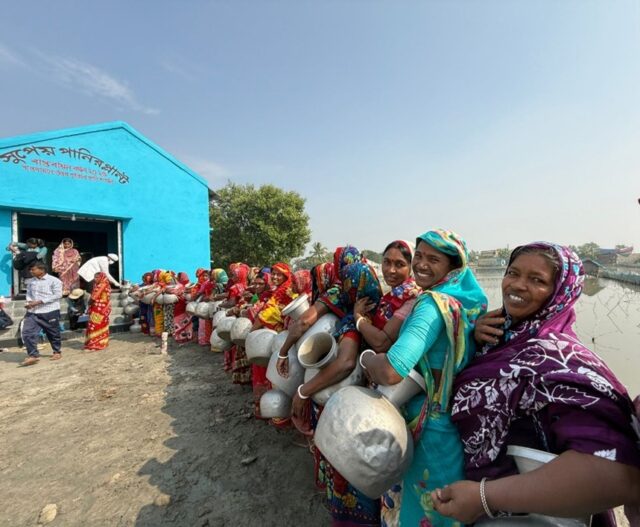
Over time, this approach leads to more relevant, deeper and more lasting outcomes. Communities grow more confident in decision-making, improve their ability to manage resources, and engage more effectively with local government. What initially may seem like a delay becomes an investment in long-term resilience.
This pattern holds across RtF Landscapes
Bangladesh is not exceptional. The same dynamic appears across other RtF contexts, and it points to something structural about locally-led approaches rather than something specific to one country.
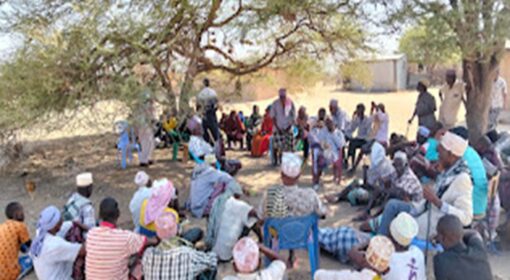
In Ethiopia, implementation timelines shifted when communities prioritised their own agricultural seasons before engaging in project activities: a rational decision rooted in food security, not inefficiency. In other cases, communities mobilised collectively to rehabilitate roads so that drilling equipment could access borehole sites. From a conventional project perspective, these look like delays. From a locally-led perspective, they are evidence of communities making real decisions about sequencing and priorities.
In Burkina Faso, Hub partners reflected that the process feels time-intensive precisely because it breaks from familiar, top-down ways of working. For many communities and sometimes even for practitioners this approach is new. It requires continuous dialogue, trust-building, and shared reflection. Strengthening collective ownership is not a one-off step; it evolves over time, and at different rhythms across communities. In one village, for instance, additional engagement was needed not to convince people, but to create space for them to reconnect with their own capacity to analyse, decide, and act collectively – capacities that previous development approaches had effectively bypassed. The Community Action Plans emerging from Burkina Faso illustrate this well. These are not administrative documents produced to satisfy a reporting requirement. They are the outcome of negotiation, dialogue, and consensus-building – often across multiple meetings, always with attention to whose voices are included. That process does not fit neatly into rigid project timelines. But it produces something that a rushed plan cannot: genuine collective ownership.
The right question
The question is not whether locally-led adaptation moves fast or slow. It is whether a process creates the conditions for communities to exercise real agency – to make decisions on their own terms, build on their own knowledge, and sustain change over time.
Rather than asking whether we should move quickly to demonstrate visible results, perhaps the more relevant question is: Do we allow enough space for communities to re-activate and exercise their own capacities, make decisions on their own terms, and strengthen collective agency in ways that last?
Going slow at the start is not a weakness. It is the investment that makes everything else possible. Resilience is not built through speed. It is built through ownership, trust, and communities leading their own future.