Speakers
Fulco Ludwig, Wageningen University
Reinier Visser, Acacia Water
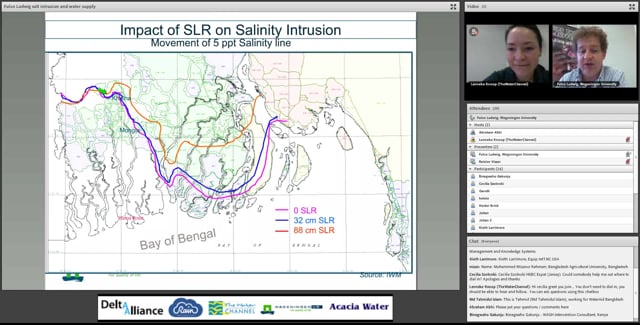
Due to sea-level rise and reduced upstream flow, saltwater intrusion into freshwater sources has expanded rapidly in southwest Bangladesh. Due to climate change and increased upstream water use, the intrusion is only going to increase.
This has grave implications for drinking water quality. Salinization of freshwater sources means that the salt intake of communities in coastal Bangladesh is very high. This is turning into a serious public health issue with an increasing number of people (especially pregnant women) at risk from high blood pressure, heart attacks, and stroke.
In this webinar, Fulco Ludwig from Wageningen University discussed how future Climate Change is set to impact urban water supply in the region. He drew upon his work in the city of Khulna. Climate models and sea level rise scenarios show that salt intrusion will only increase, rendering water south of the city unfit for drinking for several months during the year. Fulco will also discuss adaptation options such as strategic relocation of drinking water plants and water intake points. In addition, the element of water harvesting presents options like investing in ponds for storing freshwater for use during the dry season when saltwater intrusion is at its highest level. Fulco will also reflect upon what lessons Khulna holds for delta cities across the world.
Reinier Visser from Acacia Water shared experiences from Bangladesh and the Netherlands. In both countries, Acacia Water has been involved in creating freshwater bubbles underground through Managed Aquifer Recharge (MAR). MAR is a practical solution that can be implemented at a large scale in the short term.
By means of a MAR-system, freshwater coming from rainwater ponds and rooftop harvesting can infiltrate below an impermeable clayey layer into the saltwater layer. In Bangladesh, the infiltrated freshwater can be extracted through shallow wells and is used for drinking water purposes.
In the case of the Netherlands, the freshwater storage is used differently. The north-west of the Netherlands is ideal for agricultural production because of its highly fertile soils. The agricultural sector is the main source of income in the area. However, the region is also characterized by a shallow groundwater fresh-salt groundwater interface that threatens the freshwater supply. Over here, subsurface freshwater storage and optimization of drainage systems can contribute to reducing the risks of crop damage.
Presentations
Related Resources
- Article: ‘Salinity Intrusion in Changing Climate Scenario Will Hit Bangladesh Hard’ (The World Bank)
- Project Report: SWIBANGLA: Managing salt water intrusion impacts in coastal groundwater systems of Bangladesh
- Website: Bangladesh Delta Plan 2100- http://bangladeshdeltaplan2100.org/
- Video: Underground Freshwater Storage- a cross country learning
- Book: Underground fresh water storage A practical solution to increase water security in saline deltas
- Website farming water supply systems: www.dynamicwatersystems.nl and www.spaarwater.com
|
| This webinar is organized under the auspices of Delta Alliance | ||||