RESOLVE Project Closing Conference
GOPA MetaMeta and ESDU: One Voice for Advancing Regenerative Agriculture in Lebanon
By Farah Kamaleddine, Sophie Mansour, Raymond El Khoury, Frank van Steenbergen
After one year of implementation, the RESOLVE project has reached its conclusion, delivering key outcomes and practical outputs to support Lebanon’s transition from reactive, linear agricultural systems toward regenerative agriculture (RA). RESOLVE – Resource Empowerment and Sustainability for Overall Community Vitality and Environmental Resilience – is implemented by the Environment and Sustainable Development Unit (ESDU) in partnership with GOPA MetaMeta.
Explore the RAW Framework
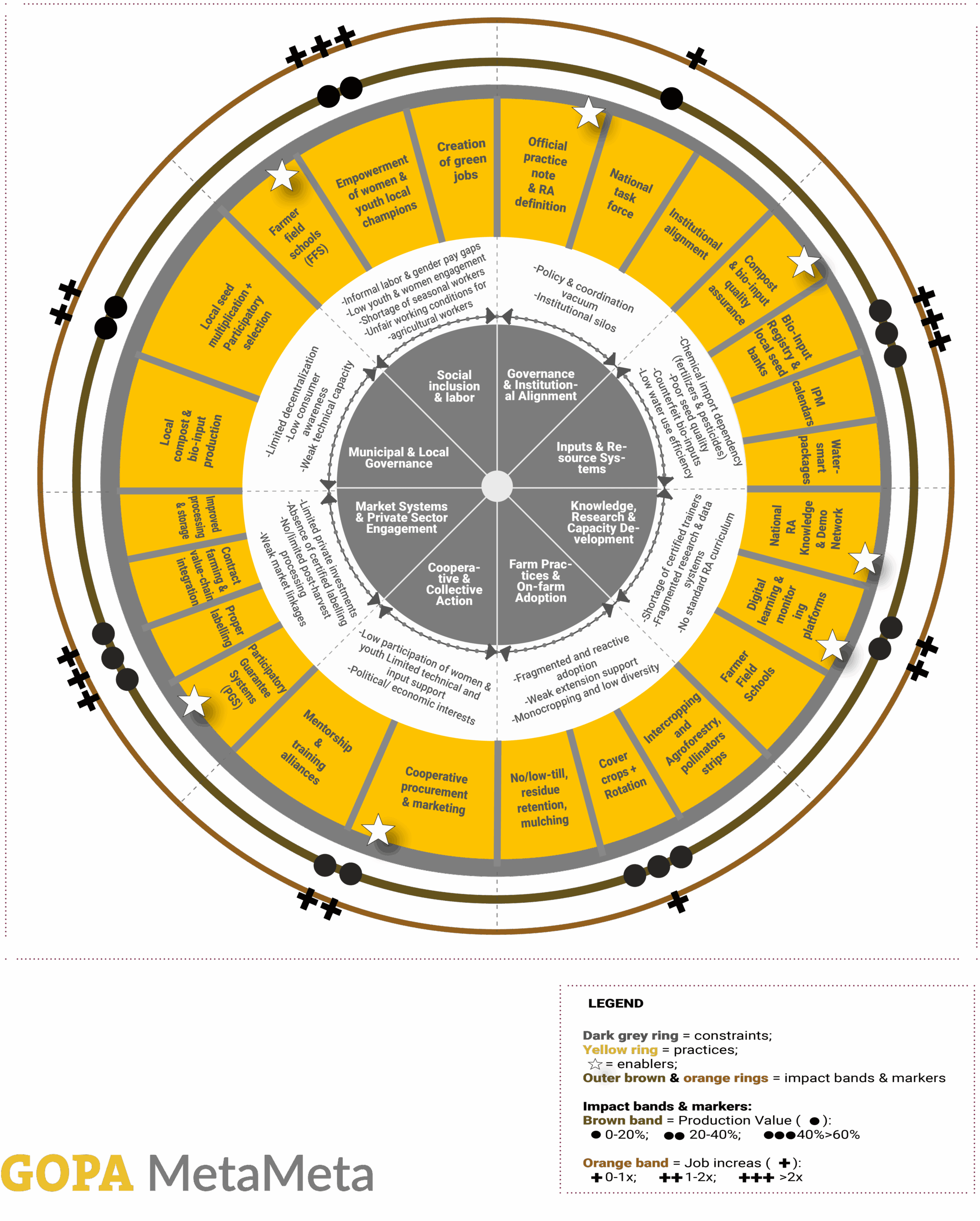
To support this shift, the RESOLVE project developed the Regenerative Agriculture Wheel (RAW), a framework adapted to the Lebanese context that captures the key domains shaping the agri-food system and highlights pathways for systemic transition. You can download the framework from here.
How to read the RAW Framework?
Unlike linear agricultural models, the RAW framework emphasizes circular feedback loops between knowledge, practice, markets, and governance, reflecting the regenerative principle that every system component sustains and reinforces the others. You can follow the legend for more clarity.
Step 1: Start at the center (innermost circle)
This is the starting point which includes eight domains that capture the full ecosystem of actors, resources, and interactions shaping Lebanon’s regenerative transition.
Step 2: Explore each domain (Middle and outermost circles)
The middle circle highlights the key constraints relative to each domain, while the outermost one details the action pathways to overcome these barriers.
Step 3: Explore impact bands (Outermost rings)
The two outermost rings represent an estimate of the impacts of the actions on two fronts: production value and job increase.
Key Takeaways
Lebanon’s agricultural sector is increasingly shaped by crisis-driven and reactive practices, limiting its ability to build long-term resilience, regeneration, and food sovereignty. While interest in regenerative agriculture is growing, its spread remains constrained by systemic barriers rather than a lack of potential.
Key challenges include persistent awareness and capacity gaps, fragmented advisory and training systems, and limited access to reliable regenerative inputs, such as quality compost, seeds, and bio-control agents. These constraints are compounded by weak market incentives, low consumer trust, and the absence of certification mechanisms. At the institutional level, the lack of a shared national definition, strategy, and coordination framework for regenerative agriculture further slows progress.
Based on key informant interviews and farmers’ questionnaires, stakeholders highlighted strong opportunities to advance regenerative agriculture by creating more demonstration plots and farmer field schools (FFS). Farmers see these as essential for building trust through visible results. Cooperatives – despite current fragmentation and underutilization – could play a key role in managing compost hubs, marketing produce and certification systems, such as the Participatory Guarantee System (PGS), if provided with targeted support and clear performance criteria. Private sector actors supply some necessary bio-inputs but need a robust national quality control and registration system to ensure consistency and market confidence. Meanwhile, universities and research institutions are testing innovative practices that position them to become national knowledge centers and lead a network of demonstration and learning hubs across the country. FFS, PGS, cooperative procurement and marketing, bio-inputs quality assurance and knowledge & demo-network hubs have been categorized as key enablers of transition in Lebanon. The Ministry of Agriculture remains central to making all of this work. Its role in defining regenerative practices, approving inputs, and linking farmers to incentives will decide how fast these changes take root. Addressing these challenges and opportunities requires moving from isolated initiatives toward coordinated, multi-stakeholder action across governance, knowledge systems, farmer practices, inputs, markets, and social inclusion.
The RAW framework will be part of the complete policy toolkit output produced within the RESOLVE project, including detailed analysis and recommendations based on KIIs, farmer questionnaires, mapping and multiple roundtables conducted by ESDU and GOPA MetaMeta.
Additional Resources
- Check out this blog introducing RESOLVE project and underpinning the principles and outcomes of Regenerative Agriculture: Lebanon’s path to resilient farming
- Check out this co-authored blog between GOPA MM and ESDU which outlines the gaps and opportunities for scaling agroecology in Lebanon here: RESOLVE in action: From Fragmentation to a Shared Agroecology Future in Lebanon
- Check out this blog detailing the approach and methodology used for EBRM implementation in Lebanon: Rodent Dynamics in Lebanon: First Insights and Community-Led Solutions
- Check out this video documenting the experience of Lebanese farmers with Ecologically-Based Rodent Management (EBRM): Resolving rodent pressure and improving farmers’ livelihoods in Lebanon
- Check out this blog documenting the lessons learnt from the co-development of EBRM solutions with the local community: The Power of Co-Development in Ecological Rodent Control
- Check out this video highlighting the urgent need to protect both blue and green water flows and adopt regenerative agricultural practices that restore soils, maximize water efficiency, and ensure sustainable farming: The Water Cycle out of Balance: Voices from Lebanon
Contact Information
For more information about the RESOLVE project or its outputs, please contact:
GOPA MetaMeta
- Farah Kamaleddine, Project Manager (Farah.Kamaleddine@gopa.eu)
- Frank van Steenbergen, Project Lead (Frank.vanSteenbergen@gopa.eu)
ESDU
- Samar Morkos, Project Coordinator (sm259@aub.edu.lb)
- Sarah El Khechen, Project Coordinator (sge17@mail.aub.edu)