By Abebaw Zeleke, ORDA Ethiopia and Nardos Masresha, GOPA MetaMeta
This blog is part of a dossier on locally-led adaptation, featuring insights and lessons from the Reversing the Flow (RtF) program. RtF empowers communities in Bangladesh, Burkina Faso, Ethiopia, Kenya, and Sudan to build climate resilience through direct funding and a community-driven, landscape approach.
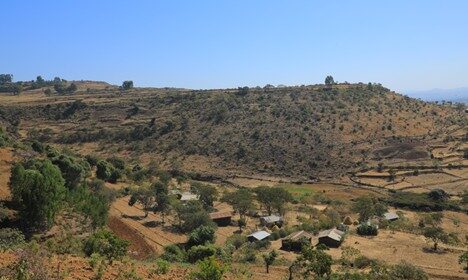
For years, water dictated the rhythm of life in Dewol Washaye, a village in Ethiopia’s Amhara Region. Women and girls organized their days and often their nights around finding it. The nearest reliable source was distant, queues were long, and there was never any guarantee that enough water would remain by the time they arrived. Some women walked before sunrise. Others waited until after dark. Collecting water was not simply another household task; it consumed hours every day, cut into time for farming and childcare, and exposed women and girls to unnecessary hardship.
Today, that routine has changed.
A modest shallow water scheme, installed through the Reversing the Flow (RtF) Project and managed by the community itself, now provides clean drinking water only a short walk away. The infrastructure matters, but what makes this story remarkable isn’t the borehole. It’s the community that owns it.
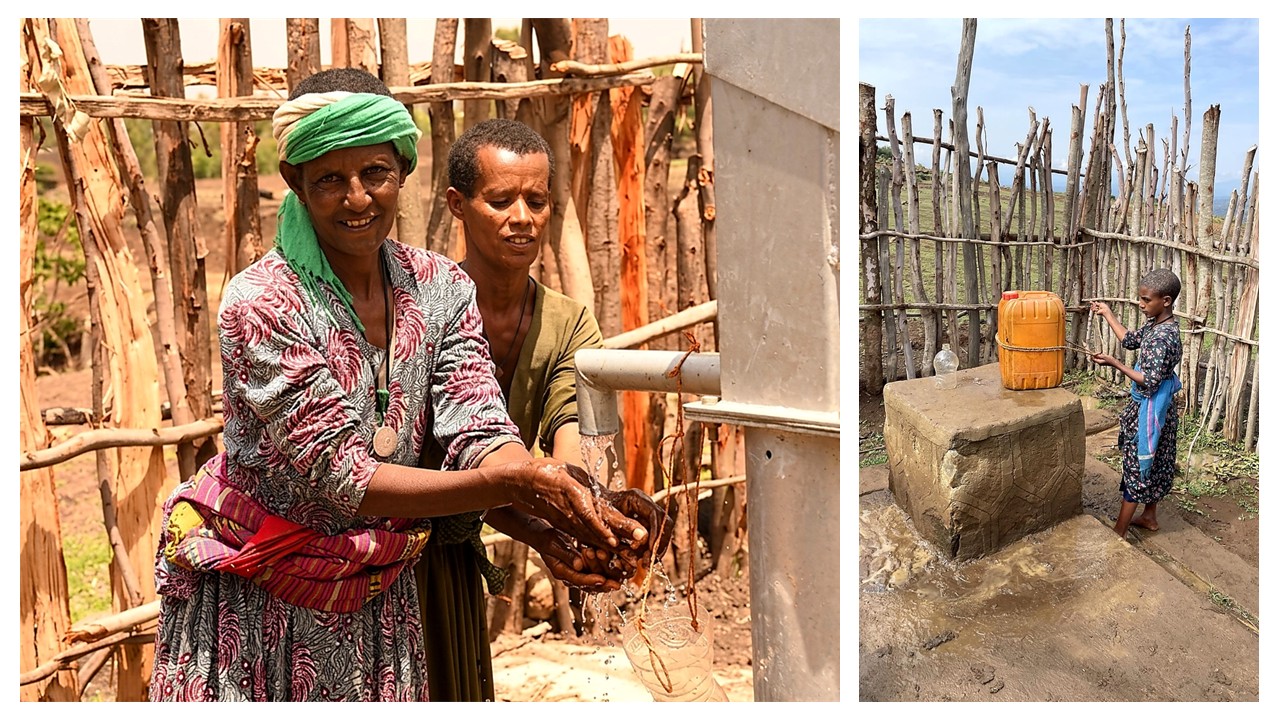
A memory of failure
The community’s optimism didn’t come easily.
More than a decade ago, another water point had been installed nearby by a different development project. Shortly after construction, a critical internal component of the hand pump failed. The community lacked the means to repair it, requests for technical support went unanswered for years, and the system was eventually abandoned with a broken pump left standing as a reminder of good intentions that hadn’t delivered.
Many development stories end there. This one didn’t.
Through RtF, the community decided to try again, but differently this time. Rather than simply installing new infrastructure, the project put local ownership and long-term sustainability at the center from the start.
A local water drilling company was identified to construct the water point and signed a contract directly with the community water committee. The committee was involved in overseeing the process and took responsibility for managing and maintaining the scheme once it was completed.
The community also established a maintenance fund, with each household using the water point contributing a small amount every month. The funds will be managed by the community and used for routine maintenance and repairs, helping reduce dependence on external support.
This was therefore more than an investment in infrastructure. It was an investment in local governance, community ownership, and a system to keep the water point functioning over the long term.
A woman at the center of the system
Every water point that keeps working has someone quietly making sure it does.
In Dewol Washaye, that person is Emebet Terefe. Living beside the water point, she oversees its daily operation, opening the facility every morning between 8:00 and 10:00, and again from 2:00 until 5:00 in the afternoon. Around one hundred collections take place there each day.
Her role goes beyond simply turning a tap. She watches over the queue, helps the community hold to its own rules, and offers a steady, familiar presence at a site that matters to nearly every household. Despite serving an entire community, she says conflict is virtually nonexistent. “People know one another,” she explained during a recent field visit. “They wait their turn.”
The rule that surprised everyone
Perhaps the most interesting lesson from Dewol Washaye isn’t about engineering at all. It’s about fairness.
Every household receives exactly two 20-litre jerrycans of water each day, for drinking and cooking. At first glance, the rule can look unfair why should a household of six receive exactly the same allocation as a household of two?
The answer says something about how this community makes decisions. When asked why water wasn’t rationed by family size, committee members explained that household size is only part of the picture some smaller families own more livestock, others have different domestic needs entirely. After weighing the alternatives, the community concluded that an equal, simple allocation would create far fewer disputes than trying to account for everyone’s differing circumstances.
The rule wasn’t designed by engineers, and it wasn’t handed down by project staff. It emerged from the community’s own discussion technically simple solution with remarkable social insight. Rather than optimizing liters per household, the community optimized something just as valuable: trust.
Building in the capacity to keep it running
Development practitioners often assume that scarcity leads inevitably to conflict. In Dewol Washaye, the opposite seems to be true because everyone understands the rules, and everyone has a hand in shaping them, the water point functions as a shared asset rather than a source of tension.
The community has also agreed, informally for now, to a modest monthly contribution of 50 Birr per household toward maintenance and, eventually, a paid attendant, a small but telling sign that people are already planning for the system’s future, not just its present.
That planning was tested early. Within its first three months of operation, the scheme broke down twice, both times traced to an internal pump component. Where the old hand pump had sat unrepaired for years for want of outside help, this time the community moved quickly, sourcing replacement parts and getting the system back functioning, by their own member trained to maintain the scheme, within about two days each time. It’s a small detail, but it marks a real shift: as a community-led initiative, the community is moving from waiting for others to fix what was broken to actively managing and maintaining its own infrastructure.
More than clean water
During field visits across the watershed, one message came up repeatedly in conversations with women.
The greatest benefit of the project wasn’t simply access to clean water. It was time, time once spent walking, waiting, or collecting water after dark, now returned to families. Some use it for farming. Some for caring for children. Some, simply, for living.
These changes are hard to capture in liters or kilometers walked, yet they may be the project’s most significant achievement.
Part of a larger story
Dewol Washaye is one of six watersheds ORDA-Ethiopia is restoring under the RtF Project, in Koti Kebele, Yilmana Densa Woreda, with support from the Government of the Netherlands. In just the first quarter of 2026, the wider project rehabilitated 119 hectares of degraded land, of which 107 hectares were permanent ex-closures and 12 hectares were farmlands, built more than 27 kilometers of soil and stone bunds, and brought clean water to 853 households through fourteen shallow wells. Alongside Dewol Washaye’s water story, 494 households across the hub have used revolving community loans to diversify their livelihoods, proof that the same locally-led approach is taking root well beyond any one watershed.
A lesson in locally led adaptation
Thousands of water points have been built across the world. Many eventually stopped functioning not because the engineering was poor, but because the communities around them were never truly put in charge of managing them.
Dewol Washaye offers a different model. The infrastructure matters. The maintenance fund matters. But what matters most is that the rules belong to the community.
The equal allocation of two jerrycans per household might look unusual to an outsider. Yet it reflects an understanding of local life that no external guideline could easily have produced.
That is the essence of locally led adaptation: communities are not simply beneficiaries of development. They are its designers. Sometimes, the solution is as simple as two jerrycans of water a day and sometimes, that is enough to change everyday life.