Arpan Mondal, Pratik Ranjan, Shubham Jain and Frank van Steenbergen
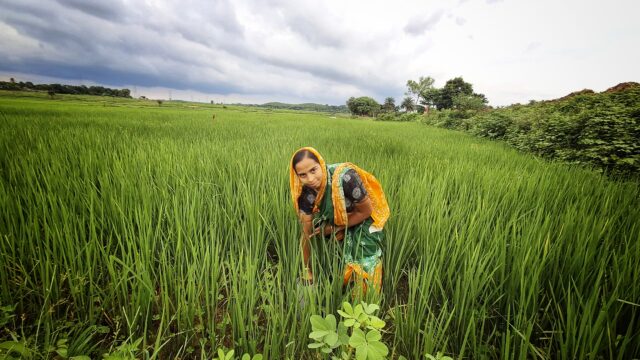
Postcard from Sitarampur. In the rainfed landscape of Bankura, West Bengal (India) the monsoon is a season of hope, anticipation but also uncertainty. Farmers wait for rain, watching the sky as closely as they watch their fields. Rainfall is the lifeline for paddy cultivation. In good years, rainfall sustains the crop. Yet, the monsoon is often erratic, and dry spells interrupt the season. In such years, farmers switch to irrigation and provide three to four waterings to protect the standing crop.
The firm belief is that paddy needs standing water. If the field surface looks dry, irrigation is applied to refill the paddy field. Water is safety, and more water means more yield.
Yet this is not necessarily so. This kharif season told a different story – for instance for Saraswati Gorain, one of the farmers in Sitarampur.
Saraswati, like others, depended on rainfall, topped with up to four copious supplies of irrigation from pumping during dry spells. This is cumbersome. Each irrigation turn means arranging fuel, labor, money – pumping water from one of the neighbor’s wells. It is costly and physically demanding, but Saraswati believed it was essential.
This year was different. Saraswati took part in a consistent training and demonstration under RVO funded Agriculture Transition Through Productive Biodiversity Program —revolving around a simple water pipe technique. A 30 cm perforated pipe was placed vertically into her paddy field, meant to monitor the water level below the soil surface, in the root zone where the plant absorbs moisture. The idea was to only irrigate when the root zone was dry – not the field surface.
Though the logic made sense it felt uncomfortable for Sarawati. The field surface sometimes looked dry, and neighbors questioned whether the crop would survive without standing water. But when Saraswati checked the pipe, she saw moisture still present in the pipe which is near the root zone. Neither did the crop seem stressed. Instead of following old habit, she followed what she observed in the pipe. Instead of the blanket irrigation of other years, she irrigated only when the water level in the pipe dropped below the recommended threshold. By the end of the season, she had applied not more than two irrigations, half of what she used earlier.
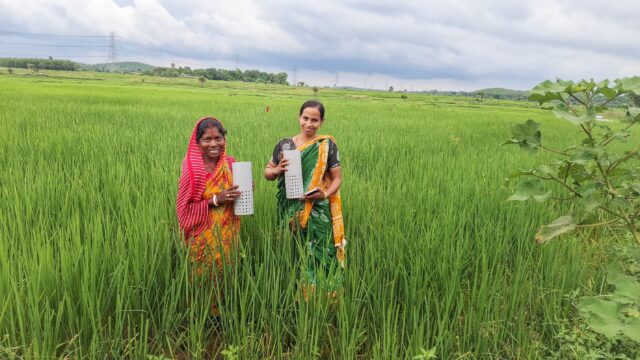
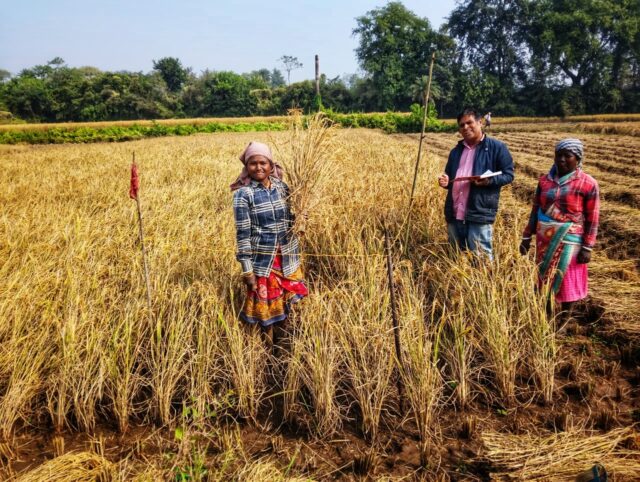
What surprised her most of all was not the water saving, but the crop performance. The paddy plants looked healthier. The roots were stronger. There was less pest pressure, especially from brown pest hopper that usually thrives, when a field is continuously flooded. The crop stood firm, with better grain filling. When harvest came, her production from – despite using only half the additional irrigation – had increased on her small 0.2 hectare plot – from 5000kg/ha to 5300kg/ha. So it less water, more yield
In a season mostly dependent on rainfall, where farmers assume more irrigation ensures safety, Saraswati experienced the opposite. With controlled and timely irrigation, she reduced water use and increased yield.
The transition to this Alternate Wetting and Drying (AWD) method was not only technical – it was a mindshift as well. She moved from irrigating based on surface dryness to irrigating based on actual root-zone moisture. From overanxious irrigation to informed decision.
In the current setting in Bankura dry spells continue to test farmers and good yield depend on monsoon mixed with groundwater use. The experience of Saraswati experience shows that even then, water management matters deeply. Lifesaving irrigation does not mean overirrigation – it means well-timed irrigation. A small, perforated pipe is what it takes to change. Agricultural transformation does not come through large infrastructure or heavy investment. It comes from understanding when to irrigate and when not.