By Frank van Steenbergen, Femke van Woesik (GOPA MetaMeta), Hugo de Boer (Utrecht University) & Stefan Dekker (NIOO-KNAW)
Reflections from the 2nd Restoring the Small Water Cycle Roundtable – 29 April 2026
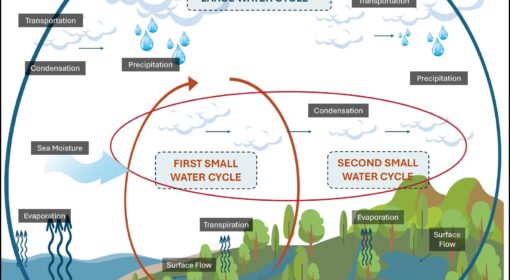
Climate action is almost entirely focused on greenhouse gases. That focus is incomplete. Landscapes themselves regulate climate: through vegetation, wind, soils, and moisture, small water cycles convert solar energy into evapotranspiration, cooling the land, recycling rainfall, and stabilising local temperatures. Where these cycles are intact, land buffers heat and extremes. Where degradation has broken them, land turns into a boiling plate, intensifying warming and aridity. Restoring small water cycles, therefore, is climate action, with direct consequences for biodiversity and health.
The small water cycle is also unusually actionable. It can be managed at the local level, effects show up within seasons rather than decades, and the direction of change is positive and reversible. This combination, manageable, local, fast, and measurable, is what makes it one of the highest-leverage interventions available during this climate crisis.
The group that gathered on 29 April during a second roundtable on this topic came with a specific purpose: to start building a roadmap for action. How do you take something this well-evidenced and turn it into coordinated action?
Half a million pits, and the land cools down
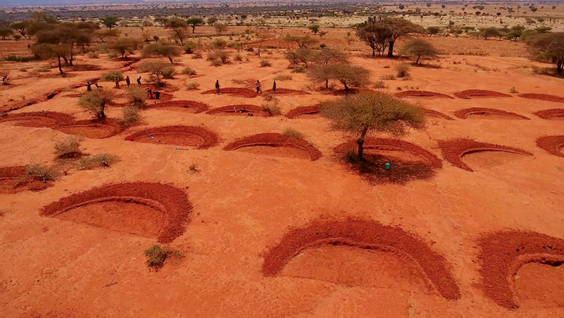
Sander de Haas of Justdiggit made the case with numbers. Over 660,000 half-moon water bunds have been dug across sub-Saharan Africa – shallow pits that trap rainfall, slow runoff, and give seeds dormant in the soil a chance to sprout. Vegetation comes back quickly, and the soil temperature drops. Satellite data confirms a significant cooling effect inside and around the bunds, measurable across hundreds of hectares, and large enough to show up in regional moisture and temperature data: soil water content is on average 7-13% wetter, NDVI shows that on average it is 23-41% greener, and temperature shows on average 0.4-0.5 degrees Celsius cooler. The effect on rainfall is anecdotal. Working with pastoral communities is central to the model: groups are paid to dig on communally owned land, with grazing agreements set in advance, and agroforestry promoted alongside food and income. Sander was direct about how Justdiggit can contribute: providing their implementation work as case studies for academic and technical partners to build a shared case for the small water cycle.
Small Water Cycles in Environmental Assessments
Alex Puisais from the Netherlands Commission for Environmental Assessment (NCEA) talked about what role Small Water Cycles can play in Environmental and Social Impact Assessment (ESIA). ESIA is where major infrastructure projects are held to account for environmental harm, and in principle, the relevant IFC Performance Standards do cover the right components: PS1 defines how impacts are identified and managed, PS3 covers resource efficiency, and PS6 covers ecosystem functions. But small water cycles are never explicitly named or defined across these standards; their core components are scattered rather than integrated, and impacts are assessed by individual environmental topic rather than as a connected land-water-atmosphere system. A case from the Mont Nimba UNESCO World Heritage site made this concrete. The ESIA for the iron ore mining project did describe local climate characteristics and dense forest cover, and it factually analyzed hydrology, water-ecosystem interactions, and erosion. What it did not do: treat small water cycles as a system, ask how the project would alter that system, or recognize local climate regulation as something the project could damage. Interactions between vegetation, water, and atmosphere, and small water cycle regulation, were never made explicit. That gap is also an opportunity. The framework already contains what is needed: the right performance standards exist, the entry points are there, and ESIA reaches exactly the kinds of major infrastructure decisions where small water cycle impacts matter most. With relatively modest reframing, ESIA could become a powerful lever for putting small water cycles on the table at the project level, across sectors, at scale.
The Small Water Cycle at the Dutch Veluwe
Stefan Dekker presented work from the Recharge Project in the Veluwe. The Veluwe is one of the Netherlands’ most studied natural areas, with decades of hydrological research behind it, and the basic water balance is still not entirely understood. Around 60% of precipitation evaporates, but measuring evapotranspiration accurately is genuinely difficult – small errors compound fast into large uncertainties in water storage. Recharge has expanded the hydrological model from 3 forest types to 18, classified by vegetation density, and installed ground sensors feeding a real-time digital twin. Early results already show that different forest types respond to drought very differently, which is exactly the type of information relevant for small water cycle restoration.
Importance of measuring evapotranspiration and soil moisture
Theo Brandsma of KNMI made a point that sounds simple and turns out to be consequential: the Netherlands has no operational monitoring network for actual evapotranspiration or soil moisture. Both are estimated from satellite imagery that performs poorly in cloudy conditions and has never been validated against ground measurements. The practical result is poor water management decisions and inadequate fire response. Nature fires in the Veluwe have become an increasingly frequent occurrence through the dry season, and without reliable soil moisture data, the ability to anticipate and respond to them is limited. The OogVoorDroog project is building this required network: data from water boards, drinking water companies, and meteorological stations, with targeted sensors where groundwater movement is poorly understood. The ambition is high-quality, validated, operational data on evaporation and soil moisture across a representative range of land use types and soil conditions. Once that network exists, the Netherlands will have the measurement foundation that small water cycle research and management currently lacks.
Water harvesting changes the temperature
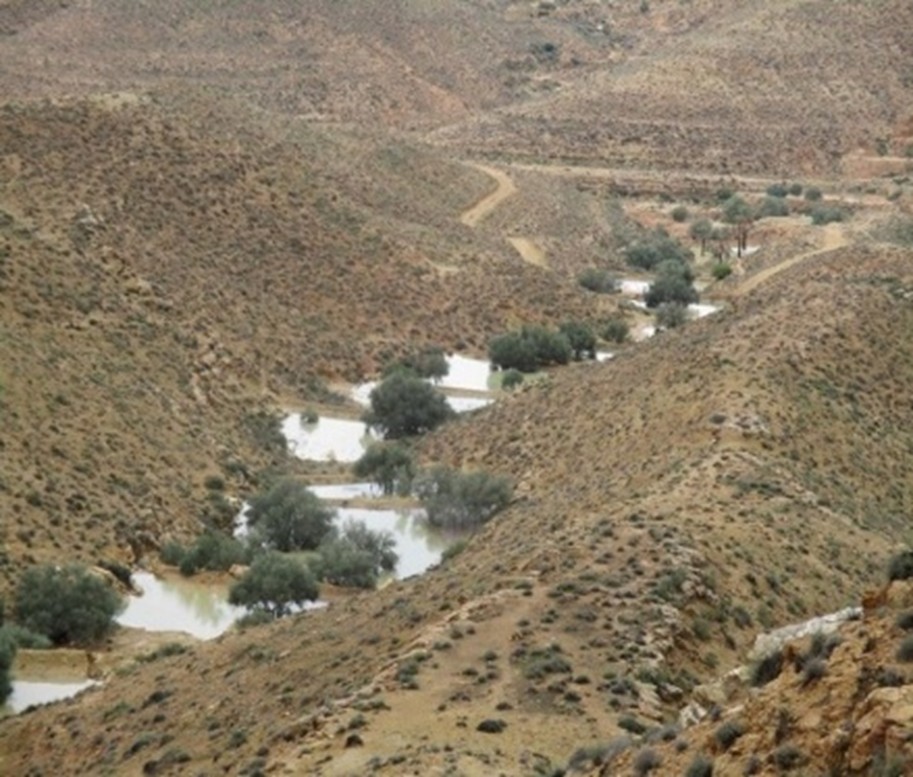
Giulio Castelli from the Water Harvesting Lab at the University of Florence presented evidence from three regions that points in the same direction. Traditional Jessour runoff and flood water barriers in Tunisia retain soil moisture through dry seasons (see this paper). Water harvesting sites in northern Ethiopia show measurably lower temperatures and higher soil moisture after implementation, confirmed by remote sensing (see this paper). A study of tree canopy cover in Tanzania found a clear threshold: above a minimum density (10% Tree Cover), land surface temperatures drop significantly. That kind of number is something practitioners can use. Giulio explained that tree cover is easier to map than water harvesting, where outcomes depend on slope, rainfall intensity, and local conditions. Getting to equally clear thresholds will take dedicated work and funding. However, temperature is the most measurable dimension of microclimate, and on that dimension, the measurements are already good enough to act.
What comes next
The scope of small water cycles is deliberately local and meso-scale, where land and water management decisions have direct, visible effects and where water, biodiversity, and human health all meet. The discussion made clear that this is not about modelling global climate patterns from the bottom up. It is about what can be managed, measured, and acted on at the level where people live and farm.
Next steps of this group is to build a community of practice that connects scientists, practitioners, and policymakers across disciplines; shape agendas in policy, practice, and science so small water cycles feature in the right conversations; bring the small water cycle perspective actively into the climate debate, including at COP; connect to what is already happening on the ground and identify where the gaps in research and practice are; and showcase existing pilots as climate action, making the evidence sharper and more visible. Alongside this, the group wants to develop a joint narrative, simple enough that someone can hear it once and pass it on accurately, and contribute to major policy debates as a recognizable expertise network.
Also, the livelihood aspect is important and must be in the frame. Heat stress on (farming) communities is already severe and will worsen. A roadmap that skips this human and livelihood dimension will not land with the communities doing the work on the ground.
A follow-up online session is planned for the end of June 2026. If you wish to be part of this community of practice and participate in the next roundtable, contact Femke van Woesik (femke.vanwoesik@gopa.eu).
See the full slide deck of this second roundtable here: