Author: Dr. Samina Memon
Department of Livestock and Fisheries, Government of Sindh
Introduction & The Ground Mission
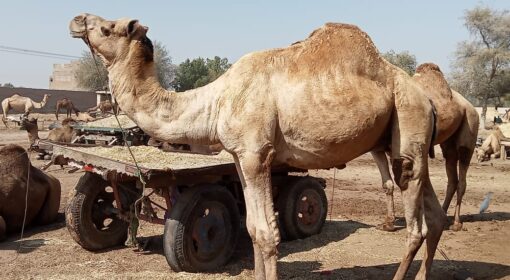
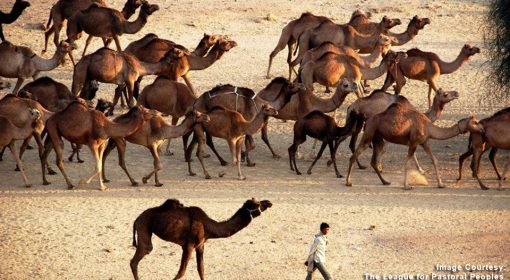
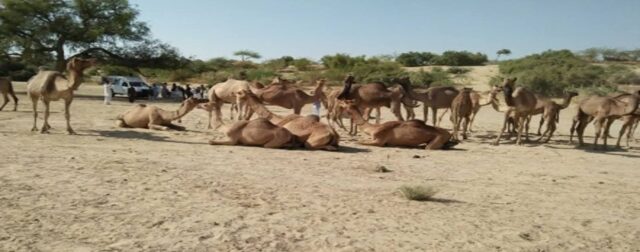
In the native rangelands of Tharparkar, magnificent herds of Dhatti camels navigate the shifting sands. The name Dhatti camel is derived directly from Dhat—a distinct region within the Tharparkar desert that spans the frontier between Sindh and Rajasthan. Because of this deep geographical connection, the local culture, the soil, and the camels of this territory are all collectively embraced under the name “Dhatti”.
Historically, open-border grazing allowed these herds to move freely across international frontiers during severe droughts, with the animals returning instinctively to their home bases once the dry spells broke. Today, as global warming intensifies and monsoon patterns shift, this animal is being repositioned from a traditional beast of burden into a premier candidate for climate-resilient dairy production.
The “Chagho” or “Chango” of the Desert
Locally, the Dhatti camel is celebrated as the “Chagho” or “Chango”, a name meaning a strong, capable, and swift runner. Structurally defined by its long legs and slim, agile body, it has evolved over centuries to traverse sandy terrains rapidly.
Traditional Age Classification
Working closely with the pastoralist communities reveals a rich repository of traditional knowledge. Local herders categorize these animals into distinct life stages based on physical growth, dental development, and strength:
- Todo (تولڈو) / Goro: A young, small camel up to 1 year of age.
- Bago (بگو): A camel that has developed its first two teeth (2-daant).
- Chogo Char (چوگو چار): A growing camel that has reached four teeth (4-daant).
- Pakat (پاکٹ): A fully mature, prime adult camel between 5 to 7 years old.
Local Insight: Herders assert that a Pakat camel possesses the raw energy, endurance, and power of two ordinary camels combined!
Nutritional Resilience & Zero-Feed Competition
Unlike conventional dairy livestock that suffer massive productivity losses during environmental crises, the Dhatti camel thrives by utilizing marginal, hyper-arid lands without competing for human food crops.
The revered Sufi saint Shah Abdul Lateef Bhittai famously honored this resilient nature in his poetry:
چَنگا چَنڊَنِ نَہ چَرِين، مَيا پِئِين نَہ مَوڪَ،
ھَڏِ نَہ لاهِیين ھوڏَ، چَنڊورِيءَ جِي چَٻَ جِي۔
- Romanized: Changa chandan na chareen, maya peeyeen na moke, Hadh na laheen hodd, chandoreeya jee chabb jee.
- English Translation: “O noble camel, you do not graze on the sweet sandalwood, nor do you drink from the abundant fresh streams. You simply refuse to break your stubborn habit of chewing the wild, thorny bushes of your desert.”
This verse perfectly mirrors the Dhatti camel; even when offered luxury, its biology and heart belong to the harsh, dry ecosystem. It converts low-value, fibrous biomass into high-quality protein where conventional animals fail.
Forage Flexibility in Hard Droughts
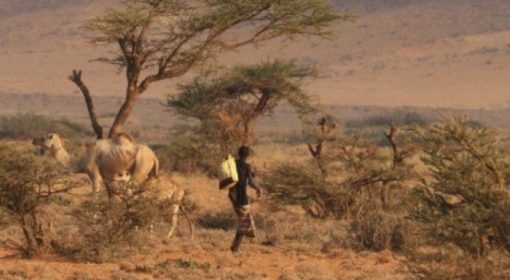
When pastures dry up, the Dhatti camel sustains itself on highly resilient, evergreen desert flora and halophytes:
- Khabbar (Salvadora oleoides): Provides vital moisture and nutrients.
- Kumbhat (Acacia senegal) & Bavri (Acacia jacquemontii): Deep-rooted, evergreen thorny browse.
- Khup (Leptadenia pyrotechnica / Arthrocnemum macrostachyum) & Jhar: Fibrous biomass turned efficiently into nutritional output.
Physiological Adaptations & Lactation Stability
The Dhatti camel exhibits persistent milk yields under extreme heat stress:
- Yield Stability: While cattle and buffalo milk yields crash by over 50% during intense heat waves (45°C to 50°C), the Dhatti camel maintains steady production.
- Lactation Length: Standard lactation lasts 12 to 18 months, ensuring continuous food security for pastoral communities.
- Daily Output: It yields 3.5 to 6 liters daily under traditional management, with a genetic potential to reach 8 to 10 liters under improved management systems.
Transforming the Camel Dairy Value Chain
Traditional Practice vs. Modern Infrastructure
In traditional history, camel milk was measured and collected in a deep pot or vessel known as the “Jungoo”, and consumption was mostly restricted within individual pastoral households. Today, modern interventions are restructuring this ecosystem:
- Chilling Infrastructure: Specialized, high-capacity milk chillers have been installed at key pastoral hubs like Chelhar to stabilize fresh yields at the source.
- Urban Logistics: Chilled milk is rapidly transported to major consumer markets in Hyderabad and Karachi.
- Nutritional Marketing: Awareness campaigns highlight its unique health benefits to urban consumers, including having low cholesterol and triple the Vitamin C content of bovine milk.
Scientific References
- Department of Livestock and Fisheries, Government of Sindh (2026). Executive Directory on the Characterization of Indigenous Sindhi Camel Breeds.
- Government of Pakistan (2026). Briefing on the Thar CAMEL Project. Senate Standing Committee on National Food Security and Research.
- Kaleri, R. R., et al. (2017/2026). Heritability Estimates for Phenotypic Traits of the Dhatti Camel Breed. Journal of Basic & Applied Sciences, 13, 556-558.