By Femke van Woesik, Frank van Steenbergen and Ellinor Guldstrand
In 1989, Robert Chambers, N.C. Saxena and Tushaar Shah wrote about a cruel paradox: in rural India, vast natural resource potentials existed side by side with the deepest concentration of Farmer poverty on earth. The poor were not simply unlucky; they were systematically excluded from resources that could transform their lives. The book was called To the Hands of the Poor: Water and Trees[1].
Thirty-five years later, the paradox still exists – but in more agonizing form. In rural Ethiopia, the land that, in principle, could feed all people is degrading, the farmers who know it best are leaving it, and the inputs that could restore productivity are priced out of reach. To the original formula of water and trees, we must add a third element: the soil itself. And with it, a new protagonist: biofertilizer.
The trap
Every day, farmers pushed off their land by worsening droughts, erratic rains, and depleted soil, arrive in Addis Ababa to find work as day labourers. Climate change has made the familiar rhythms of planting and harvest increasingly unreliable. Seasons that were once predictable enough to build a life around are now gambles. The farm that sustained a family a generation ago can no longer.
They arrive carrying almost nothing and earn barely enough. But remarkably, with a significant part of what they earn, many of them buy chemical fertilizer[2]: to help the family still on the land to harvest at least something from soil that gives less each season.
This is Robert Chambers’ deprivation trap made visible. Poverty, vulnerability, isolation, and powerlessness interlock and reinforce each other, and escape seems impossible: the farmer migrates because the farm cannot sustain the family; the farm cannot sustain the family partly because it lacks inputs; so, the farmer goes to the city to earn money to buy inputs. A loop that tightens with every dry season, every failed harvest. Yet the same land could, with the right support, the right approach, sustain him. Instead, it is pushing him further away from it.
The paradox within the paradox: Drought and chemical fertilizer
There is then the second paradox, buried inside this first one. The farmer who sends chemical fertilizer back to drought-stressed land is, with the best of intentions, potentially making matters worse. High concentrations of synthetic nitrogen and phosphate salts draw moisture out of plant roots through osmosis, intensifying water stress at precisely the moment it is already most acute. They disrupt soil microbial communities that would otherwise help retain moisture and make nutrients accessible. They compact soil structure over time, reducing the capacity to absorb rainfall. And because they require water to dissolve and move to plant roots, their nutrients may simply sit inert, unavailable, or, when rains finally arrive, run off into waterways rather than feeding crops. It is a process of degenerative farming that has evolved and become worse over the years.
The farmer who migrates to Addis to earn money to send home as synthetic fertilizer is thus caught within a trap: spending scarce earnings on inputs that may perform worse and worse and have a degrading impact under the conditions that created the need for them in the first place. On top of it, it is money spent by poor families on the produce from distant manufacturers, transferring finance away from their own poor economies. Call this the third paradox: the poor pay the rich.
Biofertilizer: A solution with local roots
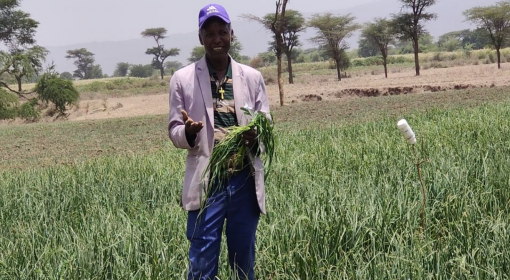
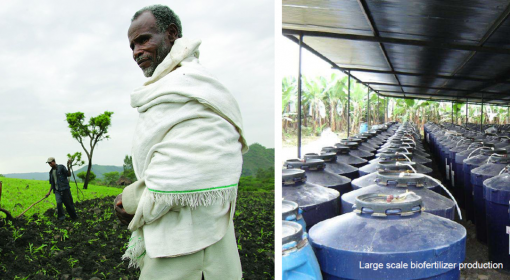
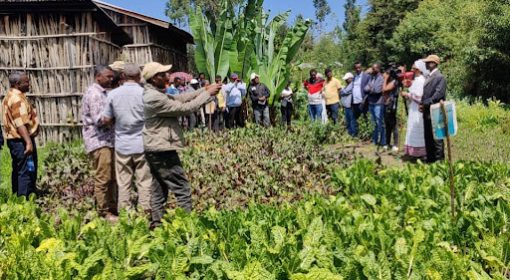
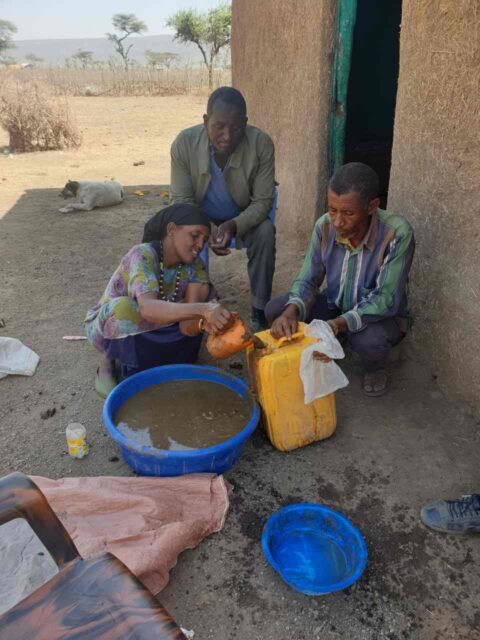
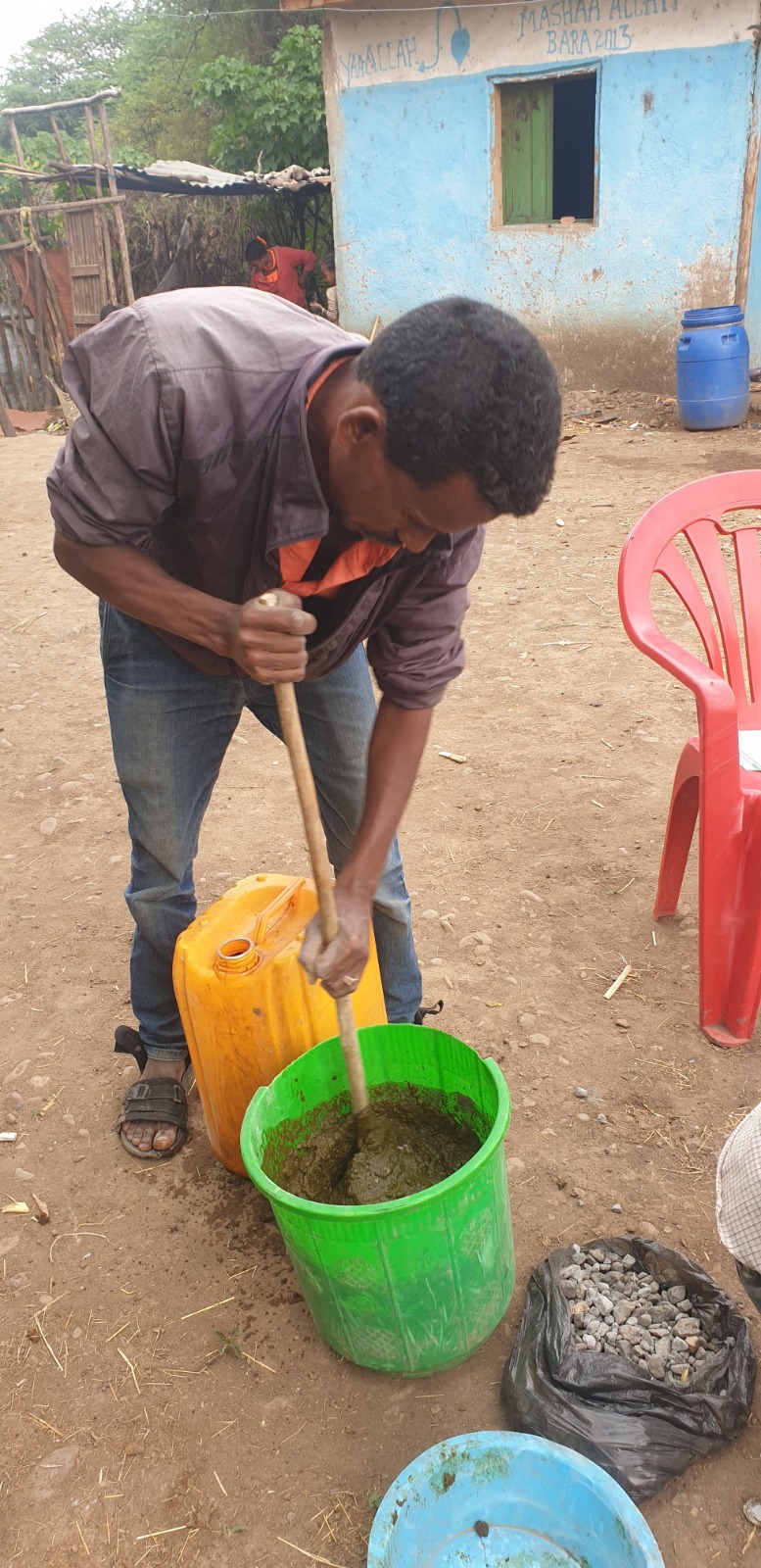
There is an alternative route: using bio-fertilizers instead of synthetic ones. Homemade liquid biofertilizers (HLBFs) are made from materials most Ethiopian smallholders already have: cow dung, yeast, sugars, and locally available organic matter. The process is simple and cheap enough for any farm household. And unlike synthetic fertilizers, HLBFs work with drought-stressed soils. Improving microbial activity, water retention, and root health rather than undermining them. Farmers in Ethiopia’s Arsi Zone who adopted HLBFs reported yield increases of 45–65% over two consecutive seasons[3].
Rebuilding the rural economy
The migration story is a broken value chain: rural labour flows to the city, converts into an external input, and flows back. Leaving the rural economy net poorer, more dependent, and no stronger than before.
Biofertilizer inverts this. When inputs are made locally, from local materials, value circulates within the rural economy instead of leaking out of it. The cow becomes a raw material supplier for soil restoration. The farmer’s knowledge becomes productive capital. The labour that was being exported to the city’s casual market is invested in the farm’s future.
This is probably the kind of intervention Chambers and his co-authors were searching for. Low-cost, locally controlled, scalable, and simultaneously addressing survival, security, and self-respect.
Change in the livelihoods of the poor rarely announces itself. It arrives as a 45% yield increase on a plot of maize. As a farmer who doesn’t need to leave for a season. As a family that stays together through a dry year. As a field that, year by year, grows a little less thirsty and a little more alive.
That is what it means to put something useful, finally, into the hands of the poor.
[2] Early findings of research by Ellinor Guldstrand
[3] Revolutionizing Ethiopian Agriculture: The Power of Homemade Liquid Biofertilizers – TheWaterChannel