This blog is part of a dossier on locally-led adaptation, featuring insights and lessons from the Reversing the Flow (RtF) program. RtF empowers communities in Bangladesh, Burkina Faso, Ethiopia, Kenya, and Sudan to build climate resilience through direct funding and a community-driven, landscape approach.
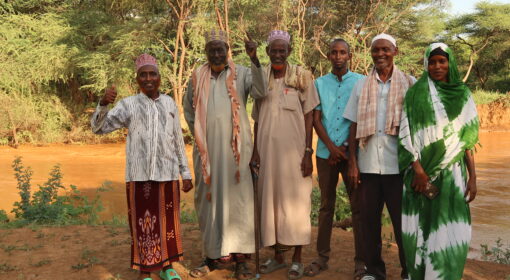
“When women have opportunities, the whole community changes. Today, we are not just surviving drought, we are preparing for tomorrow.” — Member, Enduata Women’s Group

When the Enduata Women’s Group in Ilpolei received a grant of KES 1 million (about EUR 6,800), they did not spend it on relief supplies or short-term needs. They bought 12 heifers, young cows that have not yet calved, at around KES 40,000 each (EUR 270), and 40 breeding bucks at around KES 7,000 each (EUR 47), and put the remainder into their Village Savings and Loan Association, where each loan earns a 10% return. The logic was simple: invest in assets they understood, that would appreciate, and that would keep generating income long after the grant was spent.
The choice reflects decades of hard experience. Ilpolei, in Mukogodo West Ward, is pastoralist country in Kenya’s arid and semi-arid lands, where local economies are fragmented and formal finance rarely reaches households or producer groups. Rainfall has become erratic, droughts longer and more frequent, and pasture regenerates slower than it disappears. Livestock, the main store of household wealth, die or must be sold cheap when the dry season stretches on. Women carry a disproportionate share of the consequences: longer walks for water, responsibility for feeding families, and little say over household finances despite holding households together.
The RESTORE Project, part of the Reversing the Flow programme, could have responded with a designed intervention. Instead, it took a locally led adaptation approach and handed decision-making, investment choices, and implementation to the group itself. The women chose livestock.
The numbers so far
The investments have appreciated quickly. Each heifer is now worth around KES 55,000 (EUR 370), up from 40,000. Each breeding buck has risen from KES 7,000 to around 10,000 (EUR 68). Combined with VSLA returns, the group’s capital keeps growing, and members can borrow against it at affordable rates rather than selling animals in distress.
Profits are flowing back into household preparedness. Members have bought water storage tanks to harvest rain whenever it falls, which shortens the dry-season water search and keeps households supplied when sources dry up. Others have built iron-sheet roofed houses. During dry periods, members buy livestock vaccines and supplementary feed, protecting animals before a drought kills them rather than replacing them after. Families in financial trouble get help with school fees so children stay in class through difficult seasons.
The social shift
The financial returns may end up being the smaller part of the story. As the women began managing successful investments, their position within households changed. Women who previously had little influence over money are now part of decisions on investments, education, and livestock management. Members report less household conflict, and several say domestic violence has declined, partly because financial pressure has eased and partly because women are now seen as contributors rather than dependents. A woman who brings income into the household and manages a group’s investments is treated differently, as a contributor whose judgement carries weight rather than a dependent. That change came not from a training or a campaign but from women holding economic assets of their own, a reminder that gender-based violence has economic roots as well as cultural ones, and that shifting the economics can shift the rest.
Girls in Ilpolei are watching. Mothers and neighbours running businesses and savings groups have become proof that leadership and entrepreneurship sit comfortably within cultural identity. Parents are keeping daughters in school longer, and more girls talk about becoming professionals and community leaders.
What locally led looks like
Enduata shows the approach in its plainest form. The community identified its own priorities, the women selected investments they understood, they manage the resources, they decide how profits are reinvested, and they adjust the strategy as conditions change. RESTORE’s role has been to strengthen agency that already existed, working through knowledge, institutions, and systems the community already had.
The group is one of 15 women’s groups the project supports across Mukogodo West, Mukogodo East, and Burat Wards, each running its own investments: water security work, livelihood diversification, income-generating activities, savings and credit schemes. The interventions differ. The principle is the same. The logical next step is linking these community-held investments to traders, processors, and buyers, so that capital built through grants keeps growing through the local economy. When women hold the resources and make the decisions, adaptation becomes something households own rather than something delivered to them.