By Anastasia Deligianni and David Mornout
Transforming Rural Roads for Resilience
Rural roads are the lifeline of Bangladesh’s economy, connecting people to markets, schools, and health services. Yet when roads are poorly planned, they can disrupt natural water flows, trigger flooding, erode easily, and ultimately harm the very communities they aim to serve. Across Bangladesh, these challenges are visible in eroded slopes, inadequate drainage, and unsafe bends – problems that not only threaten transport but also impact farmland, homes, and livelihoods.
Recognizing these realities, the Global Center on Adaptation (GCA) in partnership with MetaMeta Research, Socioconsult Ltd., WAVE Foundation, are working with local communities to transform rural roads into climate-smart infrastructure following the “Green Roads for Water (GR4W)” approach in Bangladesh. By integrating water management, slope stabilization, and tree planting along roads, GR4W turns road-related risks into opportunities – supporting mobility, safeguarding water and land resources, and generating new jobs.
Centering Women in Local Adaptation Planning
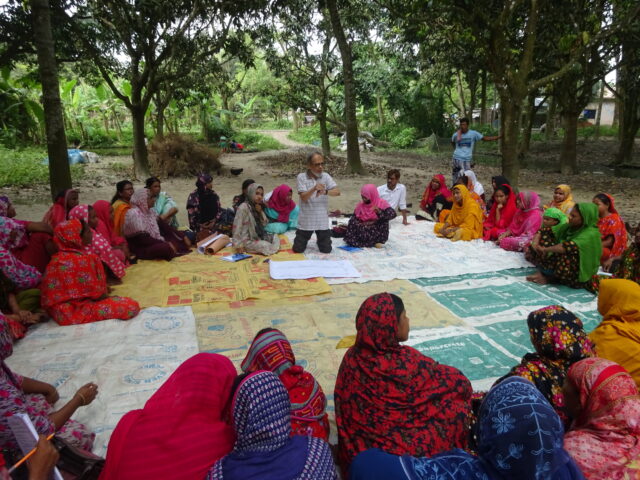
A core element of the project is women’s leadership. From October 4–8, 2024, 14 women community mobilizers participated in a hands-on training in Rajshahi. The training equipped them to guide women’s groups in developing locally led GR4W adaptation plans for their road sections. Each mobilizer will support one group in their mouza, helping to co-create solutions for road safety, water management, and climate resilience.
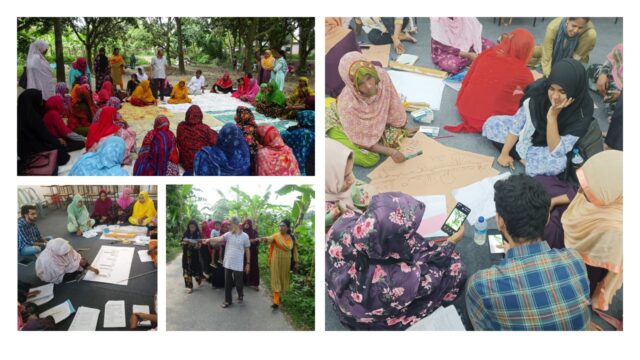
The training combined interactive sessions, group work, role play, field exercises, and reflection. Mobilizers practiced participatory tools that simulate real-world engagement, preparing them to lead discussions, document issues, and collaboratively plan interventions with their communities.
Participatory Tools in Action
The mobilizers subsequently use a set of practical, participatory tools through which they guide women’s groups along the project roads to actively engage, observe, discuss, and plan – transforming local knowledge into actionable GR4W adaptation plans. These 5 tools are elaborated upon below, and can be used also in similar contexts for different roads:
1. Road Transect Walk
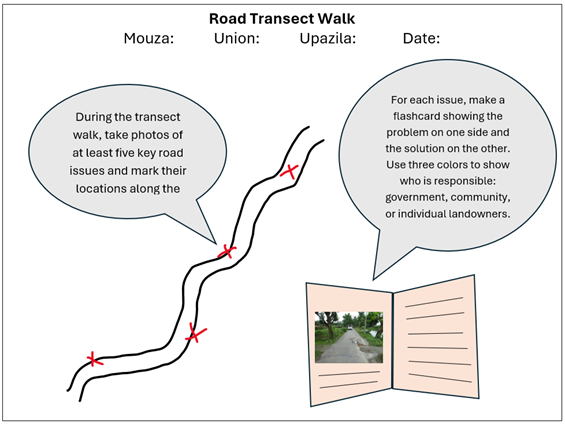
Mobilizers lead women along the road stretch in their mouza to observe its current condition and discuss possible solutions. The group identifies at least five key issues, takes photos, and prepares flashcards. Each flashcard shows the issue on one side and a proposed solution on the other. Three colors distinguish responsibilities – government, community, and individual landowners – clarifying roles in the GR4W plan. Mobilizers encourage discussion, storytelling, and ideas for resolving problems, connecting observations to actionable solutions.
2. Social & Resource Mapping
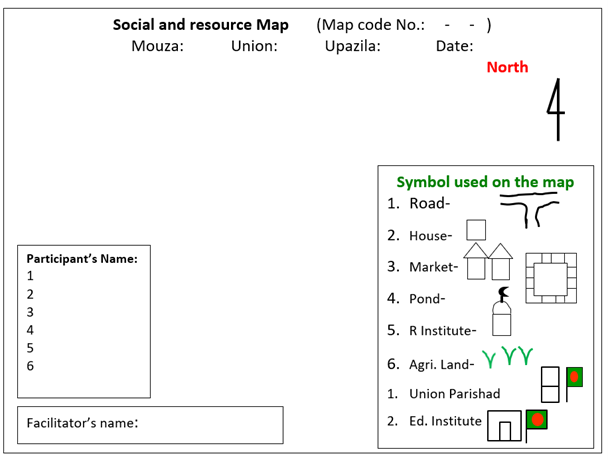
Back at the meeting space, women draw a map of their mouza, including houses, schools, mosques, ponds, trees, farms, and markets. Key issues identified during the transect walk are marked in red. Mobilizers help create a legend and redraw the map in clear markers. This final map includes Upazila, Union, and Mouza numbers, and participants’ and facilitators’ names, ensuring accurate records for later union-level consolidation.
3. Seasonal Diagram
Women discuss how different months or seasons affect their lives, farming, and road conditions. Using a horizontal line for twelve months, they place jute sticks representing months with the highest and lowest benefits, and months with major problems. Green and red lines connect the tops of benefits and problems. Women explain why certain months have challenges or advantages, including climate events, transport issues, crop cycles, or livelihoods. This visual helps the group identify patterns to inform planning.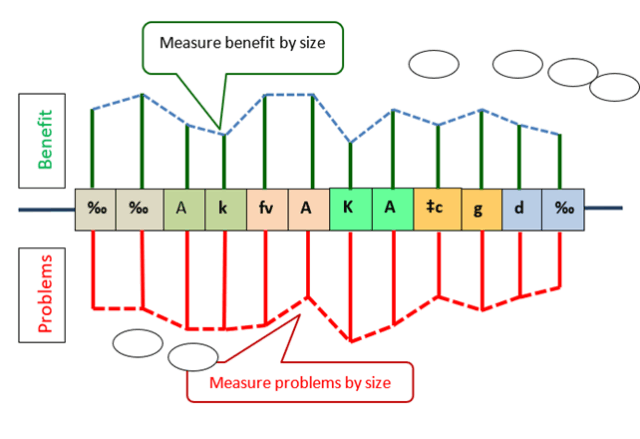
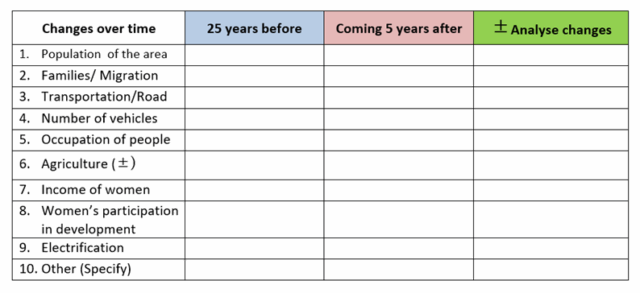
4. Timeline Exercise
The group lists key issues such as transport, agriculture, employment, migration, and uses a matrix with columns for “25 years before,” “5 years later,” and “Analysis of changes.” Participants place seeds to indicate perceptions of past and future trends. Mobilizers guide reflections on observed and anticipated changes, promoting intergenerational dialogue on environmental and livelihood shifts, which informs resilient road–water interventions.
5. Chapati Diagram
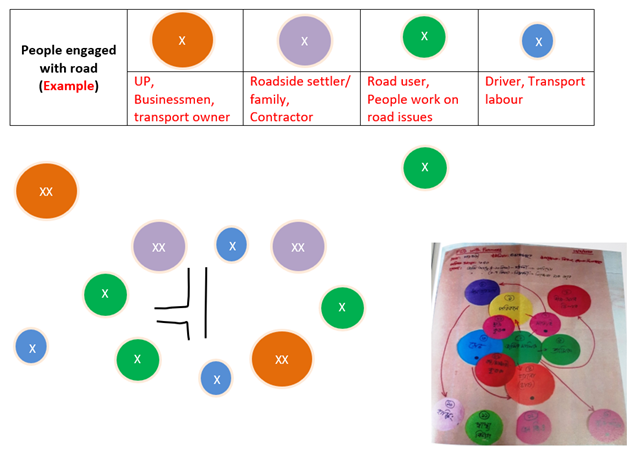
This exercise maps stakeholders in rural road management and their influence. Women list relevant actors such as road users, farmers, authorities, government departments, and select colored circles of different sizes to represent each actor. Circles are positioned around the road drawing, showing who is already involved and who is not. Arrows indicate relationships and collaboration. This helps women identify key actors for each GR4W solution and strengthen coordination.
Next Steps and Broader Impact
The participatory tools and training equip women to lead local adaptation planning for roads in their communities. Women’s groups use these tools to observe road conditions, identify key challenges, and co-create practical interventions for climate resilience, safety, and water management. The plans developed at the community level can then be consolidated and shared with local authorities and other stakeholders to inform road design, operation, and maintenance. By centering local knowledge and women’s perspectives in decision-making, this process helps ensure rural roads are safer, more resilient, and better aligned with community needs.
Overall, this approach demonstrates how community-led, participatory planning can guide the development of climate-smart rural roads, turning challenges into opportunities and building resilience from the ground up. It highlights the power of women’s leadership in shaping infrastructure that benefits people, landscapes, and livelihoods alike.