Water Security and Livelihood Gains in Tigray’s Drylands, Northern Ethiopia
By Gaddissa Deyassa and Kifle Woldearegay
Rethinking the Problem: Is It Really Water Scarcity?
Across the drylands of northern Ethiopia, water scarcity is often described as a problem of insufficient rainfall. Yet, annual rainfall in many parts of Tigray ranges between 400 and 700 mm, not insignificant for supporting livelihoods. However, the real issue lies elsewhere. Much of this rainfall is rapidly lost as runoff, leaving little time for infiltration. This situation is primarily the result of land degradation interacting with intense rainfall and the steep terrain of the region. This situation leads to a hydrological system that favors water loss over water storage. As a result, groundwater levels decline, soil dries out quickly, and agricultural systems become increasingly vulnerable to drought. Streams flow briefly after rainfall events and then disappear, while wells fail when they are needed most. This is not simply a story of scarcity. It is a story of a broken local water cycle.
Restoring the Local Water Cycle
The small water cycle is a localized circulation of water in which evaporation from land contributes to precipitation over the same terrestrial system (Michal Kravčík et al., 2007). It specifically refers to a situation where water is retained, infiltrated, stored, and recycled within a landscape. When this cycle functions properly, rainwater infiltrates into the soil, enhancing soil moisture that supports the growth of crops and vegetation. Groundwater is replenished by recharge to sustain yields from wells and springs. Also, baseflows in rivers increase and sustain during the dry season. As a result, water availability in the landscape is enhanced. In contrast, when the local water cycle is disrupted, rainfall is quickly converted into runoff, triggering erosion, reducing recharge, and amplifying drought impacts. The key question, therefore, is not how to increase rainfall, but how to keep the rain where it falls.
Three Pathways to Local Hydrological Restoration: Evidence from the dry lands of Tigray
A growing body of evidence from Tigray demonstrates that restoring the local water cycle is both possible and transformative. Three complementary approaches stand out as evidence to store water in landscapes using different approaches: i) Watershed management and groundwater recharge (Woldearegay et al., 2023); ii) Managed Aquifer Recharge (MAR) (Basel et al., 2026); iii) Road Water Harvesting (Woldearegay et al., 2019). The interventions that enhanced restoration of the local water cycle and their impacts in each pathway are discussed below.
i. Restoring the Landscape: Watershed Management in the Gulle Micro Watershed and Its Impact
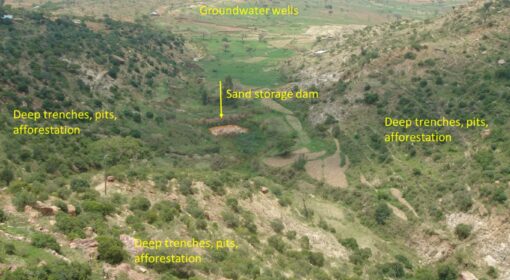
Gulle is a micro watershed with a catchment area of 12km2 situated in Tigray National Regional State (northern part of Ethiopia). Several Integrated watershed management interventions, such as SWC, terraces, exclosures, and check dams (Fig.1) had been implemented from 2001 to 2015 in the micro watershed that led to significant changes in hydrological processes at the catchment scale (Woldearegay et al., 2023).
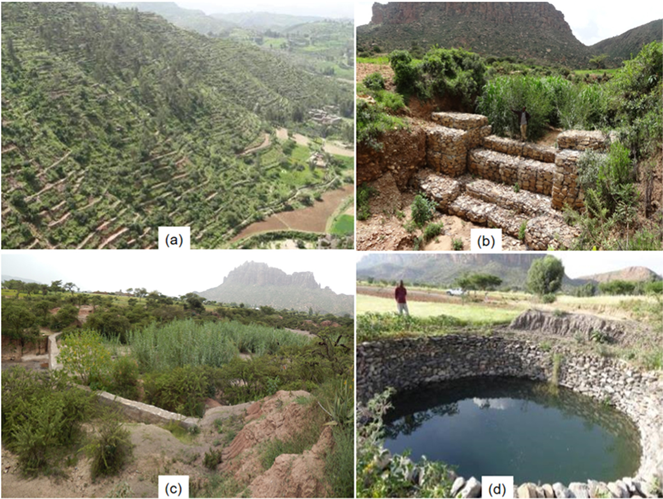
The results are striking:
- Groundwater levels improved from more than 45 meters in depth in the 1990s to about 2.6 meters (b.g.l) in the dry season and around 1 meter in the wet season
- Discharge of existing springs increased by up to 73%, and new springs have started to emerge
- Previously dry shallow groundwater wells have become productive, and the level of water in wells has risen
- Because of water availability, irrigated land expanded from less than 3.5 hectares before 2002 to 166 hectares ha in 2019. These changes reflect a system that has shifted from rapid runoff and water loss to enhanced infiltration and sustained water availability. Thus, because of the interventions, the watershed was transformed into a landscape resilient to rainfall variability.
ii. Storing Water Underground: Small-scale Managed Aquifer Recharge (s-MAR) in the Sero micro watershed
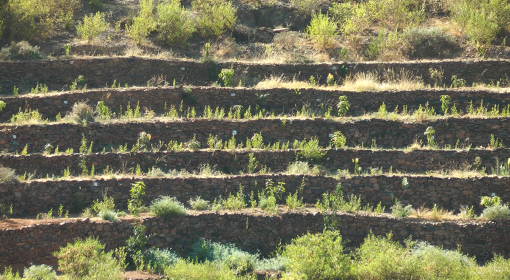
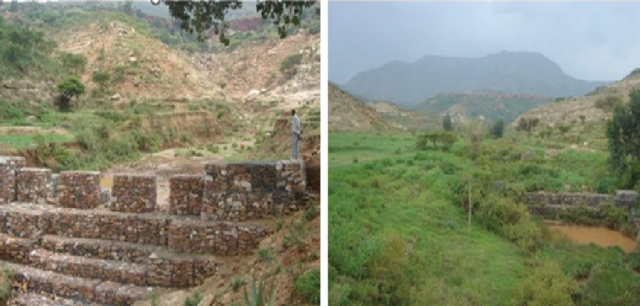
Sero micro watershed is situated in the central part of the Tigray region in northern Ethiopia. Key s-MAR interventions implemented in the micro watershed include Soil or stone bunds, check dams (Fig.2), gully restoration, living barriers, reforestation, and exclosures (Basel et al., 2026). These interventions were built aligned with social norms, governance structures, and based on local priorities. The s-MAR in this area stores water in the subsurface by slowing down runoff and allowing water to infiltrate and replenish aquifers. This enhanced groundwater availability during dry seasons and drought.
While some of the impacts are best understood through changes in system behavior rather than single figures, the outcomes are clear: increased groundwater availability supports dry-season irrigation, streamflow becomes more stable, with reduced flood peaks and extended baseflow, and Water systems remain functional even during prolonged dry periods. Therefore, in effect, communities were able to “bend the hydrograph” by reducing extremes and stabilizing water availability over time.
While some of the impacts are best understood through changes in system behavior rather than single figures, the outcomes are clear: increased groundwater availability supports dry-season irrigation, streamflow becomes more stable, with reduced flood peaks and extended baseflow, and Water systems remain functional even during prolonged dry periods. Therefore, in effect, communities were able to “bend the hydrograph” by reducing extremes and stabilizing water availability over time.
iii. Rethinking Infrastructure to manage water: Road Water Harvesting
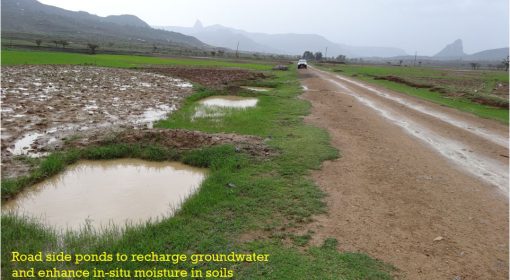
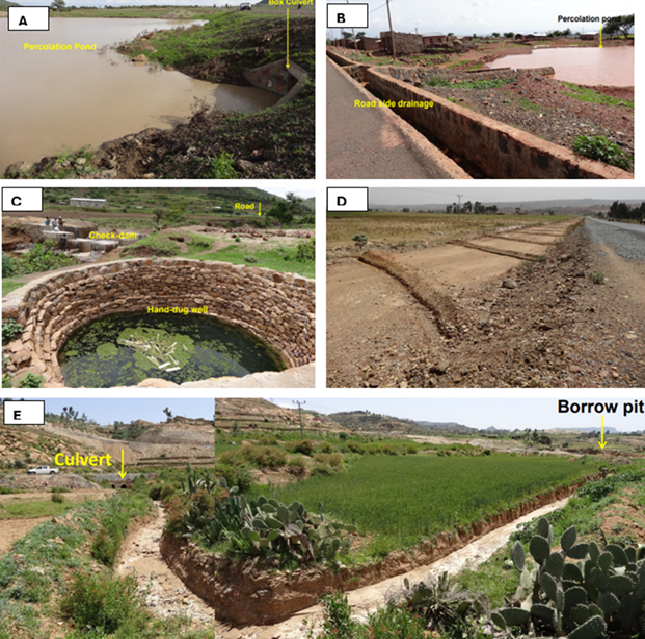
In recent years (2014-2018), road water harvesting (RWH) was systematically promoted in Tigray (Woldearegay et al., 2019). They are designed to discharge a concentrated flow of water from road hydraulic structures to opportunities for beneficial use in watershed management.
Traditionally, roads are designed to drain water away as quickly as possible. In Tigray, this paradigm has been reversed. Through road water harvesting: runoff is redirected into trenches, ponds, and infiltration structures, soil moisture increased by 70% to 100% in areas adjacent to these interventions, and groundwater levels rose significantly, with water tables reaching as shallow as 2 meters below the surface. Perhaps most importantly, wells near these systems remained productive even during the 2015 drought, highlighting their role in enhancing resilience.
A System-Level Transformation
Together, these interventions have fundamentally reshaped the way water moves through the landscapes. Before their implementation, the dominant hydrological responses were rapid runoff and severe soil erosion, minimal infiltration and groundwater recharge, declining and deep-water tables, and short-lived stream flows.
These conditions resulted in low and unstable agricultural productivity. Following the interventions, infiltration and groundwater recharge have increased, water tables have risen, and well yields have improved. Springs and baseflows are now sustained, supporting more reliable water availability. Consequently, irrigation agriculture has expanded, livelihoods have strengthened, and communities have become more resilient. This represents not just a marginal improvement but a profound hydrological transformation that supports economic resilience at the household level.
A Broader Lesson for Drylands
The experience from Tigray offers an important lesson for dryland regions across Ethiopia and beyond. Water security is often framed as a problem of climate variability or limited rainfall. But these studies show that a significant part of the challenge lies in how water is managed within landscapes. By shifting from a system that drains water away (a broken local water cycle) to one that retains, infiltrates, and stores it. It is possible to rebuild the local water cycle, enhance groundwater resources that lead to an increase in agricultural productivity, and strengthen livelihood resilience. In effect, it is a shift from Managing Scarcity to Managing the local Water Cycle. The transformation observed in Tigray did not come from increasing rainfall. It came from making better use of the rainfall that already exists. Therefore, the lesson is simple but powerful:
Water security in drylands is not achieved by waiting for more rain, but by ensuring that every drop that falls is retained, infiltrated, and stored within the landscape. That is restoring the local water cycle. Therefore, moving from runoff to recharge is not just a technical shift; it is a paradigm shift. And it may be one of the most effective pathways toward building resilient water systems and sustainable livelihoods in dryland regions.
References
Basel, J., van Steenbergen, F., & van Beek, R.. (2026). How humans bend the hydrograph: Experiences in mitigating drought through small-scale managed aquifer recharge. Water, 18(2), Article 123. https://doi.org/10.1080/07900627.2025.2602533
Kravčík, M., Pokorný, J., Kohutiar, J., Kováč, M., & Tóth, E. (2007). Water for the recovery of the climate: A new water paradigm. People and Water NGO. http://www.waterparadigm.org
Woldearegay, K., & van Steenbergen, F. (2014). Water harvesting from roads in Tigray, Northern Ethiopia: In figures. MetaMeta Research / Green Roads for Water. https://roadsforwater.org/wp content/uploads/2014/10/Visual-Road-Tour-Ethiopia-Road-Water-Harvesting.pdf.
Woldearegay, K., & van Steenbergen, F. (2019). Water harvesting from roads: Experiences in Tigray, Ethiopia. MetaMeta Research / Green Roads for Water. https://roadsforwater.org/wp-content/uploads/2019/11/Water-Harvesting-from-Roads_Experiences-in-Tigray.pdf.
Woldearegay, Kifle., Grum, B., Hessel, R., van Steenbergen, F., Fleskens, L., Yazew, E.,Tamene, L. D., Mekonnen, K., Reda, T., & Haftu, M. (2024). Watershed management, groundwater recharge and drought resilience: An integrated approach to adapt to rainfall variability in northern Ethiopia. International Soil and Water Conservation Research, 12(3), 663–683. https://doi.org/10.1016/j.iswcr.2023.08.009.